Towing a Boat with the GMC Sierra 1500: A Maine Owner’s Guide
If you own a boat in southern Maine, your truck does as much real work in May through October as it does the rest of the year combined. Hauling from the garage to the launch, navigating tight ramps at low tide, backing carefully into the water with a $40,000+ boat behind you — boat towing is one of the most demanding things you’ll ask your truck to do.
The good news: a properly-configured 2026 GMC Sierra 1500 handles nearly every boat trailered in Maine. The right engine and equipment depend on your boat’s weight, where you launch, and how often you tow. This guide walks through engine selection by boat class, the ProGrade Trailering System features that matter most at the ramp, specific Maine launch tips, and the pre-launch checklist we recommend to every boat-owner customer at our Arundel showroom.
Quick Answer: Best Sierra 1500 Engine by Boat Weight
Bass boats / runabouts under 4,000 lbs: Any engine (2.7L TurboMax is more than enough)
Center consoles / pontoons 4,000–8,000 lbs: 5.3L V8 is the sweet spot
Cruisers / sport boats 8,000–10,000 lbs: 5.3L V8 (with headroom) or 6.2L V8
Heaviest hauls or frequent long-distance towing: 3.0L Duramax diesel (max 13,300 lbs towing, best fuel economy)
Always remember: Boat weight is just part of the equation. Trailer weight, fuel, gear, and tongue weight all factor in — see the weight calculation section below.
Engine Selection by Boat Weight Class
Boat marketing weights are usually “dry weight” — the boat alone, no fuel, no gear, no trailer. Real-world towed weight is typically 30-50% higher once you add the trailer, fuel, batteries, ice, gear, and water in the bilge. Here’s how that plays out across boat categories common in Maine waters:
Bass Boats and Small Runabouts (Under 4,000 lbs Towed Weight)
Examples: 16-19 ft bass boats, jet skis on dual trailers, small aluminum fishing boats, Boston Whaler Montauks. Recommended engine: Any Sierra 1500 engine. The 2.7L TurboMax (310 hp / 430 lb-ft, 9,400 lbs max towing) handles this category effortlessly. Trim recommendation: Pro, SLE, Elevation — no need to step up for towing alone.
You’ll barely notice the boat behind you with any of these setups. The TurboMax’s 430 lb-ft of torque arrives at low RPM, which makes pulling out of launches and merging onto Route 1 feel responsive even with the boat in tow.
Center Consoles, Pontoons, and Mid-Size Boats (4,000–8,000 lbs Towed Weight)
Examples: 20-23 ft center consoles, 22-24 ft pontoon boats, mid-size walkarounds, classic runabouts. Recommended engine: 5.3L V8 is the sweet spot — 355 hp / 383 lb-ft / 11,200 lbs max towing. Plenty of headroom for the load. Trim recommendation: SLT, AT4, or any V8-equipped trim.
This is the largest single category of boats trailered in southern Maine, and it’s exactly what the 5.3L V8 was designed for. The V8 sound and torque make highway hauls comfortable, and the 11,200-lb capacity gives you significant safety margin even loaded with passengers and gear.
Cruisers, Cuddy Cabins, and Large Sport Boats (8,000–10,000 lbs Towed Weight)
Examples: 25-28 ft cabin cruisers, larger center consoles with twin outboards, day cruisers with trailer-friendly designs. Recommended engine: 5.3L V8 (with limited headroom) or 6.2L V8 for confident long-distance hauling. Trim recommendation: SLT, AT4, or step into Denali / Denali Ultimate / AT4X for the 6.2L V8 standard.
At this weight, the 6.2L V8 starts to feel meaningfully better than the 5.3L — extra power for grades, faster passing speeds when fully loaded, and the 10-speed automatic gives you more precise gear matching. If you’re planning to upgrade to a larger boat in the next 3-5 years, buy the bigger engine now.
Larger Cruisers and Heavy Boats (10,000+ lbs Towed Weight)
Examples: 28-32 ft cruisers, large pontoon boats with high-horsepower power, fishing boats with large twin outboards and full tanks. Recommended engine: 6.2L V8 (up to 13,100 lbs towing) or 3.0L Duramax diesel (up to 13,300 lbs towing). Trim recommendation: Denali, Denali Ultimate, AT4X, or any trim with the Duramax diesel option.
This is where the diesel earns its premium. The Duramax’s 495 lb-ft of torque means the truck barely registers the load, fuel economy is dramatically better than a gas engine pulling a heavy load, and you have margin for additional cargo, passengers, and longer trips. For owners who tow 10,000+ lb boats regularly to vacation properties or distant launches, the Duramax pays for itself.
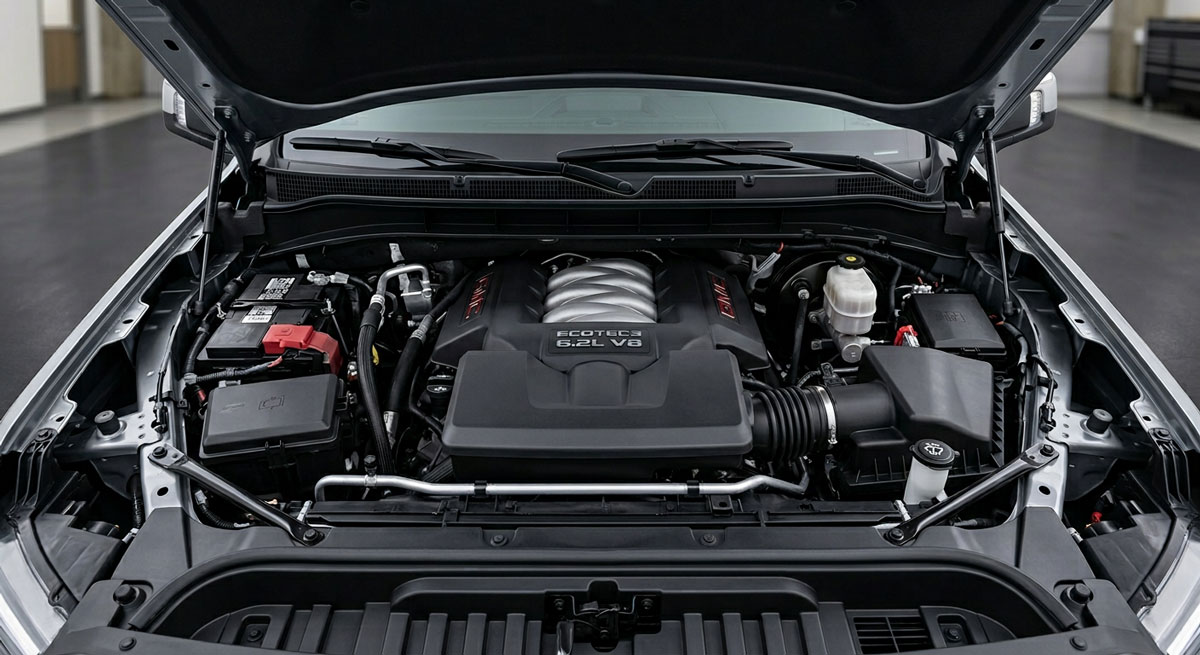
For boats 8,000 lbs and up, the 6.2L EcoTec3 V8 (420 hp / 460 lb-ft) provides confident power and the 10-speed automatic for precise gear matching.
Tongue Weight and Weight Distribution: The Numbers Most Owners Miss
Tow capacity is the headline number, but tongue weight is what often catches owners off-guard. Tongue weight is the downward force the trailer puts on your truck’s hitch ball — and it counts against your truck’s payload capacity, not your towing capacity. Here’s how the math actually works:
The Standard 10-15% Rule
For most boat trailers, tongue weight runs 10-15% of the total trailer weight (boat + trailer + fuel + gear). For a 6,000-lb total load, that’s 600-900 lbs of tongue weight pressing down on your hitch.
Why It Matters
That 600-900 lbs comes out of your truck’s payload — which also has to cover passengers, gear in the cab, gear in the bed, and any aftermarket accessories you’ve added. A typical Sierra 1500 Crew Cab has 1,500-1,800 lbs of payload depending on configuration. With four adults (640 lbs), some gear (100 lbs), and 800 lbs of tongue weight, you’re at 1,540 lbs of payload used — close to or over the limit on some configurations.
Real Sierra 1500 Example
Say you own a Sierra 1500 SLT Crew Cab 4WD with the 5.3L V8. Max tow rating is around 10,500 lbs. Payload is around 1,650 lbs. You’re towing a 7,500-lb boat-and-trailer combo with 850 lbs of tongue weight.
Trailer: 7,500 lbs (well under 10,500 max — no concern)
Tongue weight: 850 lbs
Driver + passenger: 350 lbs
Gear in cab and bed: 200 lbs
Total payload used: 1,400 lbs (under 1,650 — within limits)
If you added two more passengers and a cooler full of ice, you’d cross the payload limit before crossing the tow limit. That’s the trap most owners fall into.
Pro Tip
Bring your VIN to our service desk at Weirs GMC and we’ll pull your truck’s exact GVWR, payload, and tow ratings off the door jamb sticker. Combined with a quick conversation about your boat and typical loadout, we can tell you whether you’re operating safely within your truck’s capabilities.
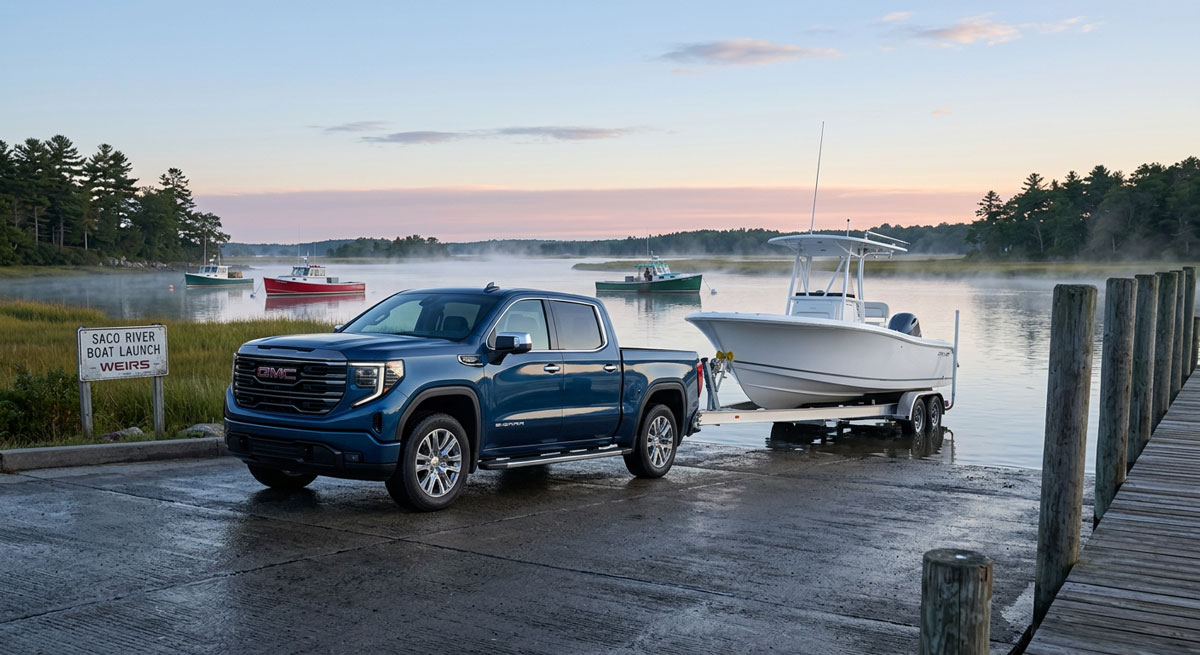
The 2026 GMC Sierra 1500 ready to launch at the Saco River — one of Southern Maine’s most popular boat ramps. Weirs GMC, Arundel, ME.
The ProGrade Trailering System at the Boat Ramp
If you’ve ever waited behind someone struggling to back a boat trailer down a narrow ramp on a busy summer Saturday, you know how much technology helps. The Sierra 1500’s available ProGrade Trailering System has features built specifically for boat ramp scenarios:
Hitch View and Hitch Guidance
A dedicated camera shows you the hitch ball and trailer coupler from above as you back up. Lines guide you to perfect alignment without needing a spotter. For solo boaters or anyone who’s done the get-out-look-back-in dance, this saves real time at the ramp.
Transparent Trailer View
One of the most useful features for boat owners. As you back the trailer down the ramp, the system uses cameras and software to make the trailer appear “transparent” — letting you see directly behind the trailer for obstacles, dock pilings, swimmers, or other vehicles.
Side Blind Zone Views
Dedicated side cameras show you what’s beside the trailer — useful for navigating narrow ramp areas, parking with the boat behind you, or pulling out of tight launch parking lots in summer.
Bird’s-Eye Trailer View
A composite top-down view shows the truck and trailer together. For aligning with a tight ramp angle or navigating a launch parking lot, it’s the angle you can’t get any other way.
Custom Trailer Profiles
Save individual profiles for each boat trailer you tow. Trailer length, width, brake settings, tire pressure thresholds — all stored in the truck and recalled automatically. If you have a fishing boat and a different trailer for a kayak setup, both are saved.
Maine Boat Launch Tips by Location
Every launch has its quirks. Here’s what to know about the most popular launches near our Arundel showroom:
Saco River Launches (Saco / Biddeford)
Multiple launches along the Saco River serve the local boating community. The lower-river launches near the Atlantic see the most traffic in summer. Tides matter here — at low tide, ramps can be steep and slick with algae and seaweed.
What to know: Use 4WD Low when launching at low tide on steeper ramps. The truck’s hill descent control helps maintain controlled speed backing in. Bring a towel — saltwater spray on your truck’s tailgate and rear window is part of the experience.
Sebago Lake (Standish, Naples, Sebago)
Maine’s largest freshwater lake and a destination for serious boat owners. Multiple public launches around the lake serve different boat sizes — Songo Lock at the north end is popular but can back up significantly on summer weekends.
What to know: Sebago has paved launches in good condition, but parking lots fill early on weekends. Plan to arrive before 8 AM in July and August. The drive from Arundel is about 75 minutes — Adaptive Cruise Control on Route 25 makes it easier.
Casco Bay (Portland Area)
Multiple public launches serve Casco Bay, including East End Beach and Spring Point Marina launches. These see heavy commercial and recreational traffic.
What to know: Tides matter heavily here too. Several launches have meaningful tidal ranges (8-10+ feet). Plan launches around tide tables, not just clock time. Backing your boat into 6 inches of water vs. 6 feet of water is a different experience.
Biddeford Pool
A protected harbor area with launches that serve smaller boats well. Beautiful setting, busy in season.
What to know: Limited parking. Smaller ramp areas mean technique matters. The ProGrade trailer cameras shine here — backing into tight angles with limited space is exactly what they’re designed for.
Kennebunkport / Cape Porpoise
Smaller launches serving the local communities. Generally less crowded than the Saco or Casco Bay launches but with their own challenges (narrower roads, tighter turns).
What to know: The drive in matters as much as the launch — tight turns through historic neighborhoods. Practice tight-radius reverse turns before your first launch attempt.
The Pre-Launch Checklist We Recommend
Before you leave home for the launch, run this checklist. The Sierra 1500’s in-vehicle Trailering App can walk you through most of it — but the discipline of doing it manually a few times builds the habit.
Trailer hitch and safety chains: Properly seated, locked, and crossed under the tongue.
Trailer lights: Brake lights, turn signals, and running lights all functional. Check at the launch parking lot once more before backing in.
Trailer brake controller: Set to the appropriate level for your trailer weight (heavier trailer = more braking force).
Tire pressure: Check trailer tires AND truck tires. Trailer tires often deflate slowly during winter storage.
Boat tie-down straps: Bow strap, stern straps, transom safety chains. Loose boats are the most common ramp incident.
Drain plug: Either installed (for trailering) and removed before launch, OR removed before trailering to drain water — depending on your boat. Forgetting this either way is a mess.
Fuel: Truck fuel for the trip. Boat fuel can wait until you’re at the marina or launch fuel pump.
Weather check: Wind, tide times, marine forecast. Especially for ocean launches.
4WD engaged before backing: Especially on slick or steep ramps.
Common Mistakes Boat-Towing Owners Make
Skipping the brake controller: Boats with electric trailer brakes need a properly set brake controller. Without it, your truck does all the stopping and your trailer pushes you forward — dangerous on grades and at speed.
Underestimating tongue weight: See the math above. Adding passengers and gear pushes you over payload before you’re over towing capacity.
Backing in 2WD on a wet ramp: Use 4WD or 4WD Low for any wet, algae-covered, or steep ramp. The traction difference is significant.
Pulling out before unhooking the bow strap: Sounds obvious, but it happens regularly at busy launches. Develop a consistent pre-launch sequence and stick to it.
Forgetting tide times at ocean launches: Backing the trailer 30 feet into the ocean at dead low tide is a different proposition than backing 6 feet at high tide. Plan accordingly.
Not adjusting your driving for the trailer: Allow extra following distance, brake earlier, signal turns sooner, and take wider turns. The boat behind you tracks differently than your truck alone.
Frequently Asked Questions
Can a 2026 GMC Sierra 1500 tow a boat?
Yes. The 2026 Sierra 1500 tows up to 13,300 lbs when properly equipped — enough for nearly every boat trailered in Maine, from small bass boats to large cabin cruisers. The right engine choice depends on your boat’s total towed weight (boat + trailer + fuel + gear).
What size boat can I tow with a Sierra 1500?
The 2026 Sierra 1500 can tow nearly any boat under 13,000 lbs total trailered weight when properly equipped — typically including boats up to 30 feet. The 2.7L TurboMax handles boats under 9,400 lbs. The 5.3L V8 handles boats up to 11,200 lbs. The 6.2L V8 handles up to 13,100 lbs. The 3.0L Duramax diesel handles up to 13,300 lbs and is best for owners who tow heavy boats regularly.
What’s the best Sierra 1500 engine for towing a boat?
For most boats trailered in Maine (under 8,000 lbs), the 5.3L V8 is the sweet spot — strong enough, characterful, and reasonably efficient. For larger boats (8,000-13,000 lbs) or frequent long-distance towing, the 6.2L V8 or 3.0L Duramax diesel are better choices. The diesel offers the highest tow rating and best fuel economy.
Do I need 4WD to tow a boat?
4WD isn’t required for most flat or paved launches, but it’s strongly recommended for any wet, steep, or algae-covered ramp — which describes most ocean launches and many lake launches in Maine. The traction difference between 2WD and 4WD on a slick ramp is significant. If you launch ocean boats at all, 4WD is essential.
What is the ProGrade Trailering System?
The ProGrade Trailering System is the Sierra 1500’s available trailering technology package. It includes hitch guidance, transparent trailer view (lets you “see through” the trailer behind you), bird’s-eye trailer view, side blind zone cameras, custom trailer profiles, pre-departure checklists, and trailer tire pressure monitoring when properly equipped. It’s particularly useful for boat ramp scenarios.
How much tongue weight does a typical boat trailer have?
Boat trailer tongue weight typically runs 10-15% of the total trailer weight (boat + trailer + fuel + gear). For a 6,000-lb total load, that’s 600-900 lbs of tongue weight. Tongue weight counts against your truck’s payload capacity, not your towing capacity — which is why payload often becomes the limiting factor when towing a boat with passengers and gear.
Does the Sierra 1500 come with a trailer brake controller?
Yes, an integrated trailer brake controller is standard on most Sierra 1500 trims and adjusts the electric brakes on your trailer based on truck deceleration. It’s a critical safety feature for towing any trailer with electric brakes — including most boat trailers over 3,000 lbs.
What’s the best launch in southern Maine for a Sierra 1500 with a 24-foot boat?
For a 24-foot boat (typically 6,000-8,000 lbs total trailered weight), most southern Maine public launches work well. The Saco River launches are convenient for owners in our service area, with paved ramps and reasonable parking. Sebago Lake’s launches are larger and accommodate bigger boats but require a longer drive (about 75 minutes from Arundel). Casco Bay launches are great for ocean access but demand awareness of tides.
Find the Right Sierra 1500 for Your Boat
If you’re shopping a Sierra 1500 with boat towing in mind, the most important conversation we’ll have is about your specific boat — make, model, total trailered weight, where you launch, and how often. We can match you to the right engine, configuration, and trim faster in five minutes of focused conversation than you could narrow it down on your own in an afternoon of research.
Stop by our Arundel showroom, or give us a call. If you already own your boat, bring its specs along — we’ll pull the matching trucks from inventory and walk you through the options.
About Weirs GMC: Weirs Motor Sales has been a family-owned GMC dealership in Arundel, Maine for over 65 years, serving Biddeford, Saco, Kennebunk, Kennebunkport, and all of southern Maine. We see boat owners come through our showroom every spring looking for the right truck for the season ahead — and our team genuinely understands the local launches, tides, and what southern Maine boating actually looks like. If you have boat-towing questions this guide didn’t answer, we’re here to help.