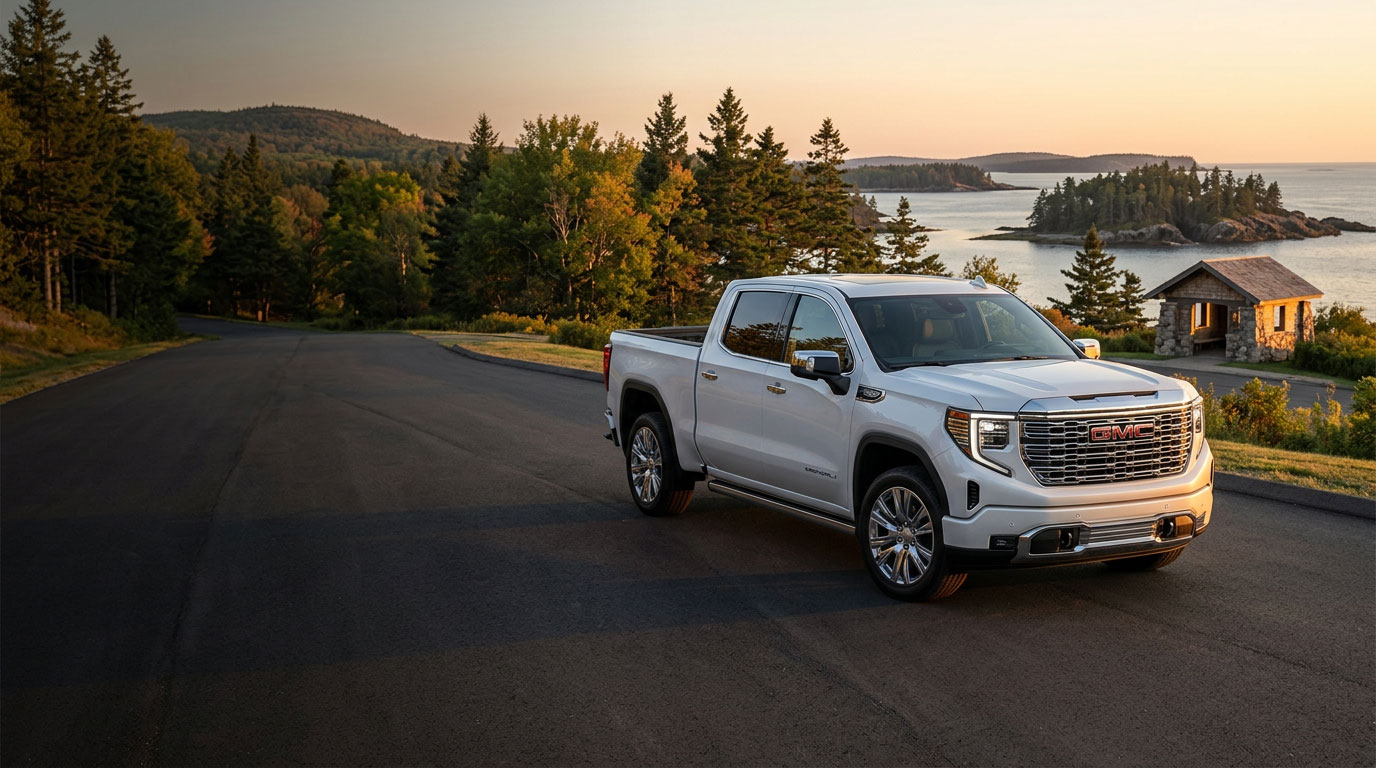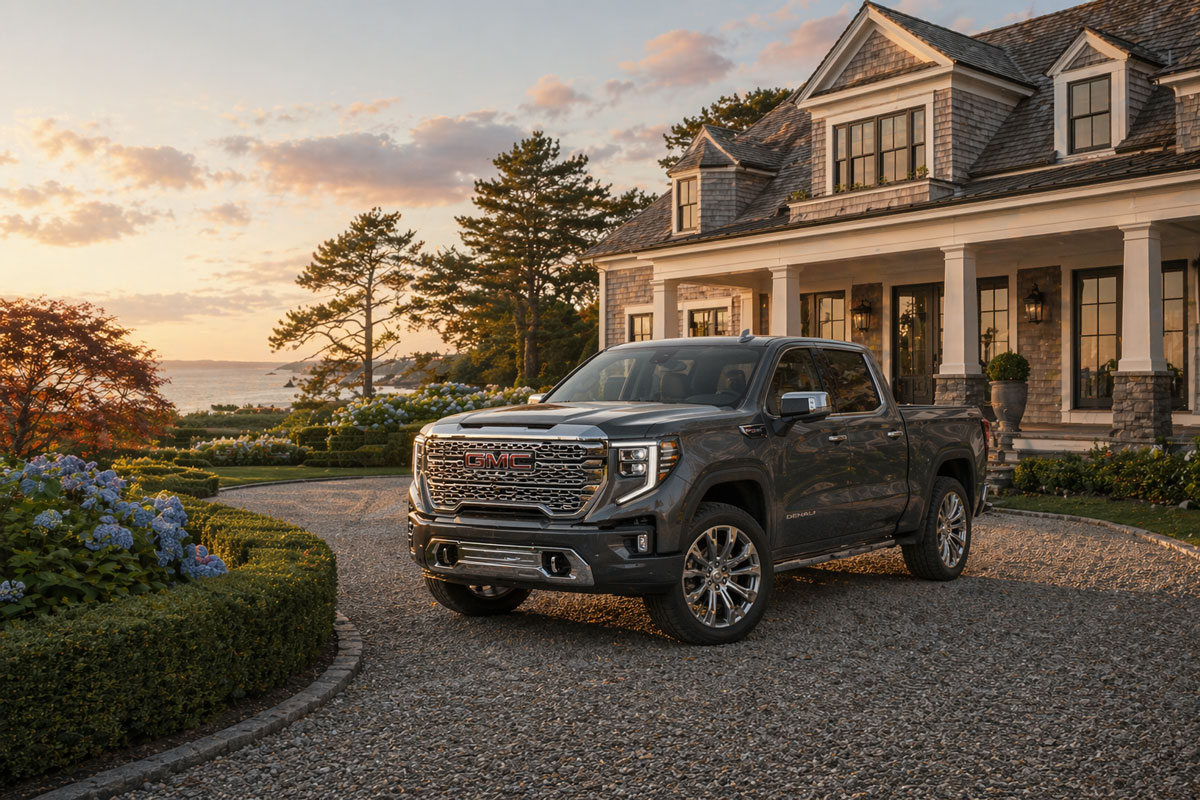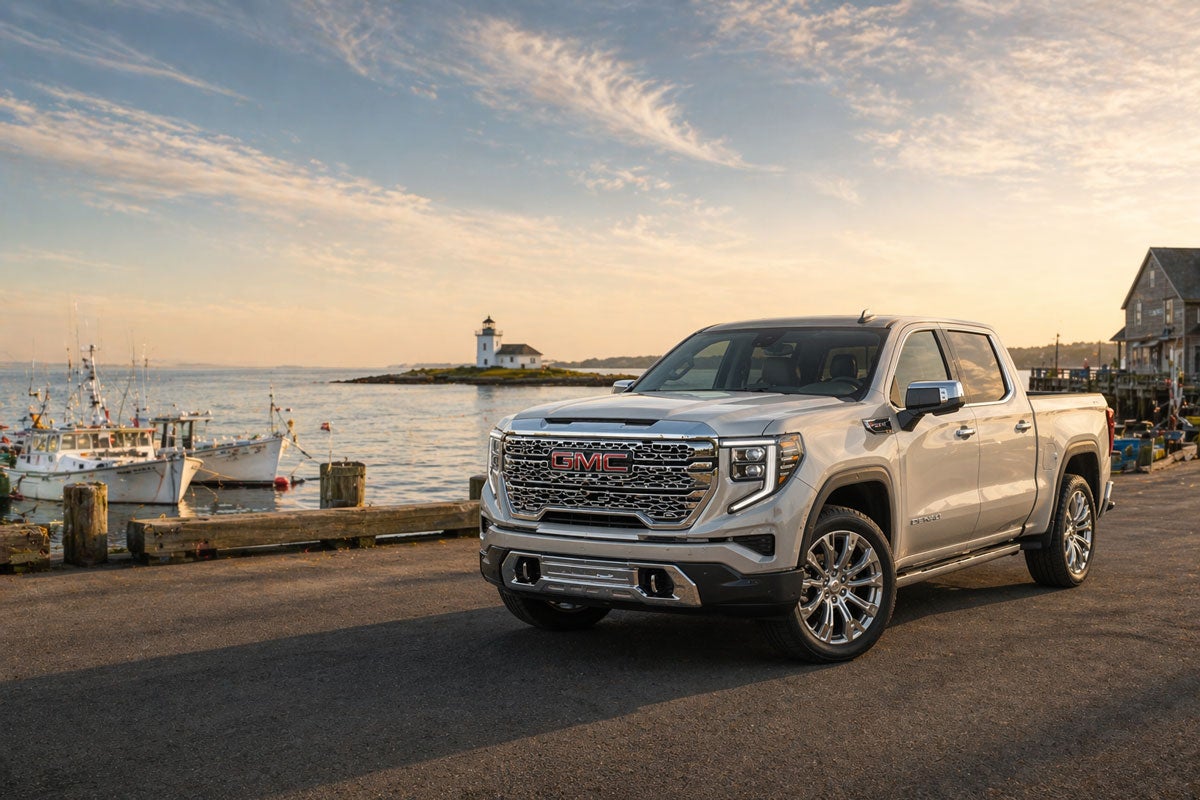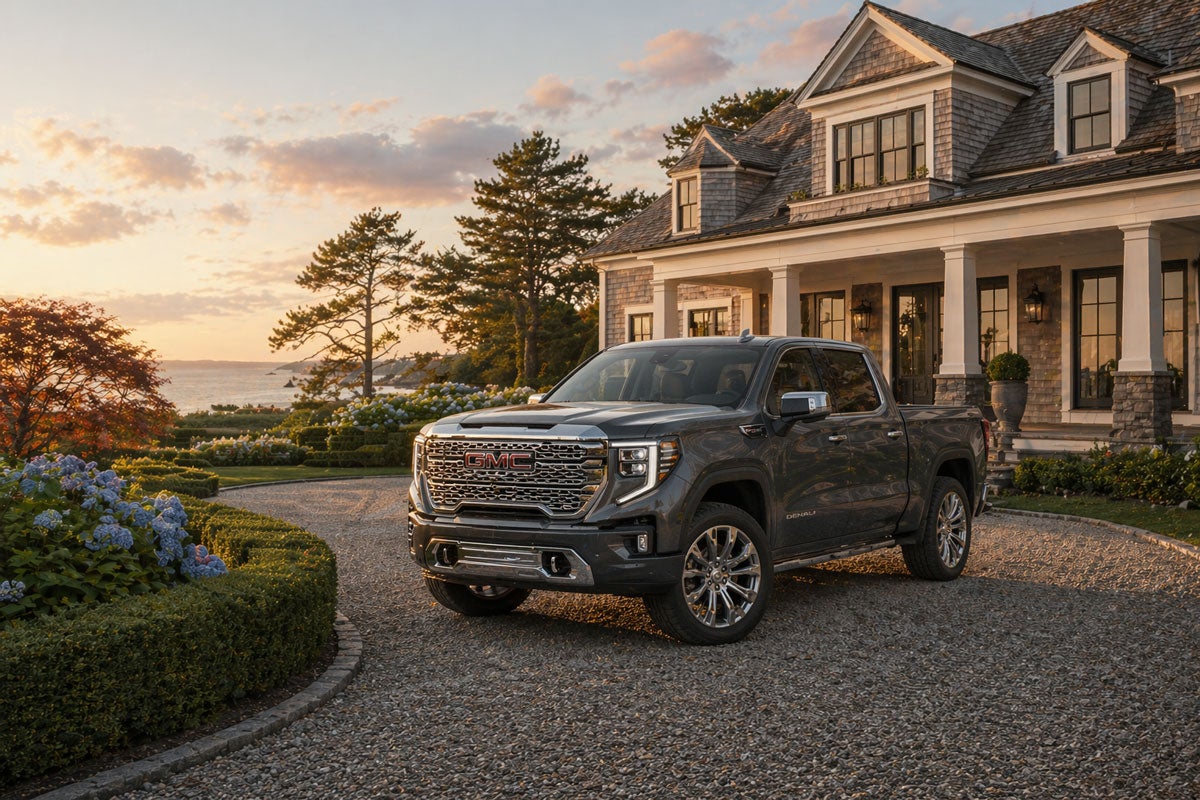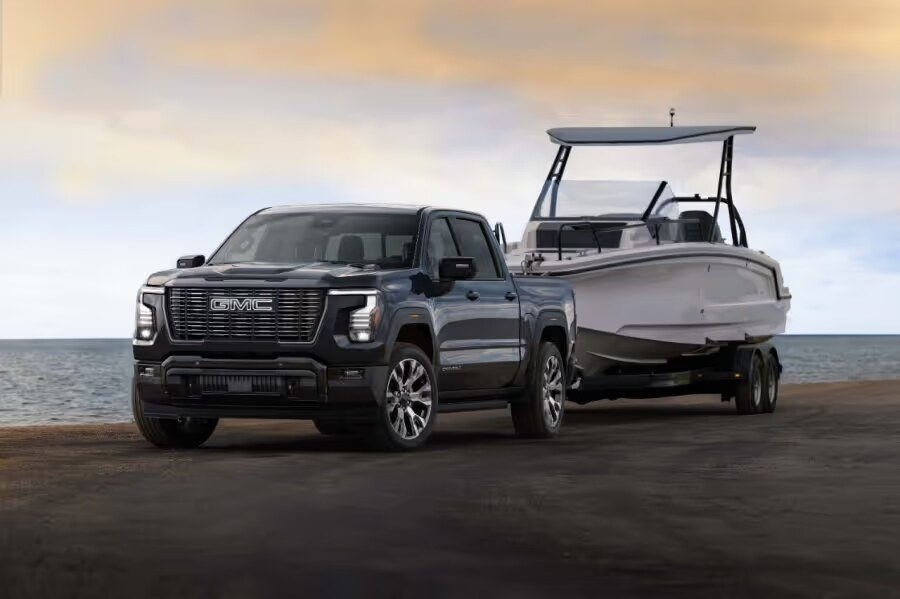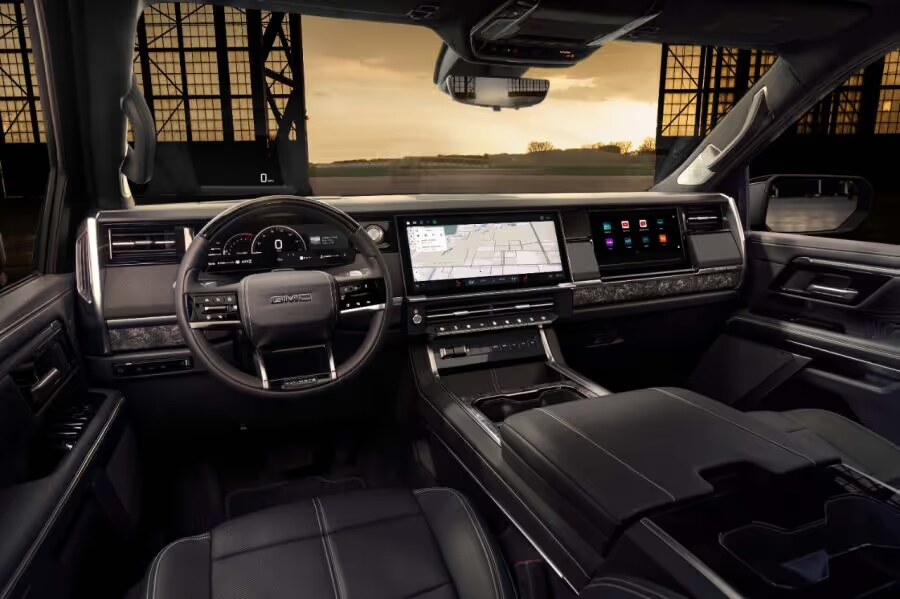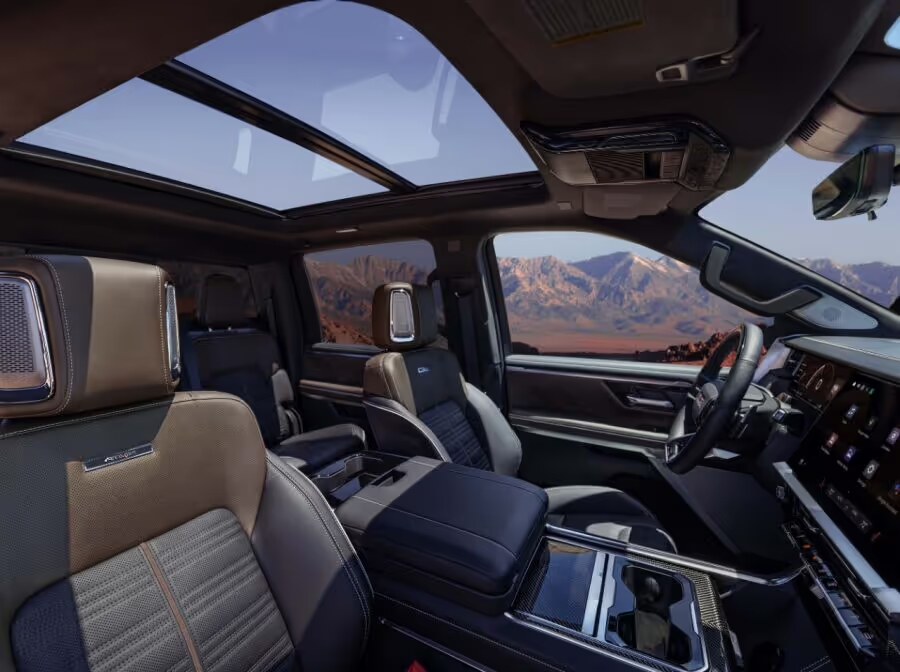

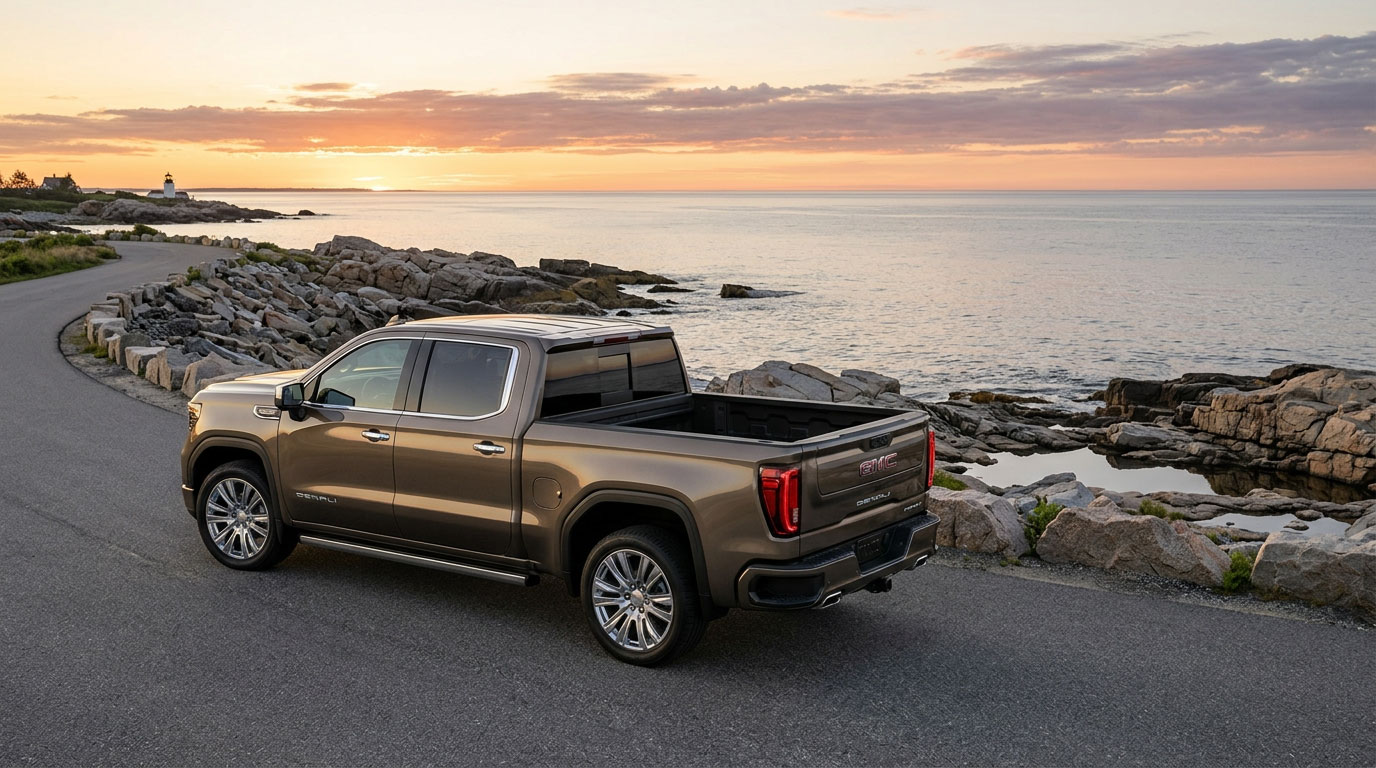
The 2026 GMC Sierra 1500 Denali Ultimate — the flagship of the Sierra lineup, photographed at a southern Maine coastal estate.
2026 GMC Sierra 1500 Denali vs. Denali Ultimate: Which Luxury Trim Is Worth It?
If you’ve narrowed your 2026 GMC Sierra 1500 search to the Denali tier, you’re already shopping at the top of the lineup. The question that comes next — and the one we hear most often at our Arundel showroom — is whether the Denali Ultimate is worth the roughly $16,800 jump over the standard Denali.
The short answer: it depends on how you’ll use the truck and what specific features matter most to you. The Denali is already a fully realized luxury pickup. The Denali Ultimate adds a layer of premium materials, technology, and design flourishes that justify the price for some buyers and feel like overkill to others. This guide breaks down every meaningful difference so you can decide which one fits your life.
Quick Answer: The Key Differences
Price gap: About $16,800 (Denali starts at $69,390 / Denali Ultimate starts at $86,190)
Grille: Traditional Denali chrome vs. Vader Chrome (Denali Ultimate)
Seats: Heated and ventilated leather (Denali) vs. 16-way power with massage and full-grain leather with plaited stitching (Denali Ultimate)
Super Cruise: Available option (Denali) vs. Standard with 3-year OnStar plan (Denali Ultimate)
Sunroof: Optional (Denali) vs. Standard power sunroof (Denali Ultimate)
Both trims share: The 6.2L V8 with 420 hp, 10-speed automatic, 13.4″ Google Built-In touchscreen, 12.3″ digital instrument cluster, 15″ Head-Up Display, Bose premium audio, and the GMC Pro Safety suite.
2026 Sierra 1500 Denali vs. Denali Ultimate: Side-by-Side
Here’s how the two luxury trims compare on the features that actually drive purchase decisions:
Feature
Sierra 1500 Denali
Sierra 1500 Denali Ultimate
Starting MSRP
$69,390
$86,190
Engine
6.2L EcoTec3 V8 (420 hp / 460 lb-ft)
Transmission
10-speed automatic
10-speed automatic
Wheels
20-inch polished aluminum
22-inch Ultra-Bright machined aluminum
Grille
Denali chrome with signature pattern
Vader Chrome (dark chrome treatment)
Front Seats
Leather-appointed, heated & ventilated
16-way power, full-grain leather with plaited stitching, heated, ventilated, massage
Sunroof
Optional
Power sunroof standard
Super Cruise
Available (additional cost)
Standard with 3-year OnStar plan
Infotainment
13.4″ touchscreen with Google Built-In
Audio
Bose Premium 12-speaker
Bose Premium 12-speaker with Centerpoint surround
Head-Up Display
15″ multicolor
15″ multicolor
Towing
Up to 13,100 lbs
Up to 13,100 lbs
The Denali Ultimate cabin — full-grain leather with plaited stitching, 16-way massage seats, and the 13.4″ Google Built-In touchscreen.
Where the Denali Ultimate Earns Its Price
The price gap between Denali and Denali Ultimate is about $16,800. Here’s what you actually get for that:
1. The Seats Alone Are a Real Difference
This is the upgrade most owners notice every single drive. The Denali’s leather-appointed, heated, and ventilated seats are excellent — they’re a major step up from the SLT below. But the Denali Ultimate’s 16-way power front seats with massage and full-grain leather with plaited contrast stitching are in a different league entirely. The massage function isn’t a gimmick — on a long drive from Biddeford up to Bangor or down to Boston, it makes a real difference in how you feel when you arrive. The full-grain leather has a depth and softness that leather-appointed surfaces don’t match.
2. Super Cruise Is Standard (and That Saves You Money)
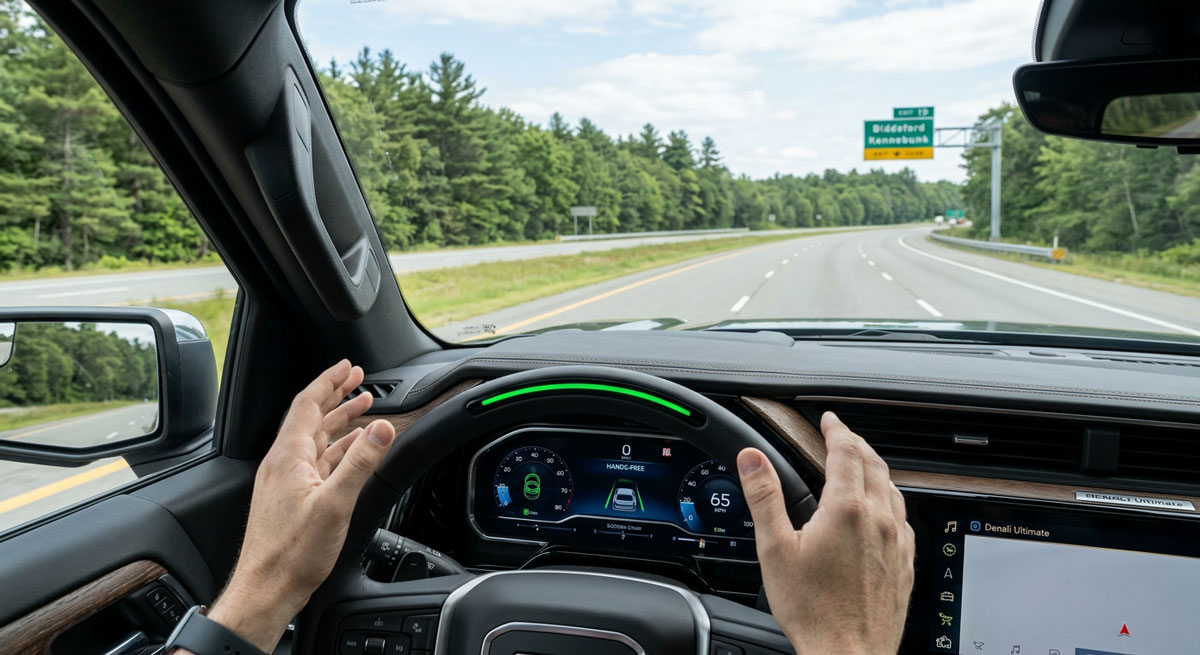
Super Cruise is GM’s hands-free highway driving technology, and it’s genuinely impressive. On the Denali, it’s an available option — meaning you’ll pay extra to add it, plus an OnStar subscription after the trial expires. On the Denali Ultimate, it’s standard equipment with a 3-year OnStar Connected Services plan included. If you were planning to add Super Cruise anyway, this closes a meaningful chunk of the price gap.
Super Cruise works on over 400,000 miles of compatible highways across North America — including the entire Maine Turnpike (I-95) corridor that runs right past our dealership.
3. The Wheels Make a Visual Statement
The Denali’s 20-inch polished aluminum wheels look great. The Denali Ultimate’s 22-inch Ultra-Bright machined aluminum wheels look different — bigger, more reflective, and unmistakably the flagship. Whether that matters depends on whether you care about your truck’s curb appeal. For owners who’ll park in front of clients, customers, or a Kennebunkport summer home, the 22s read as an obvious upgrade.
4. Vader Chrome Grille
The Vader Chrome grille on the Denali Ultimate is darker than the standard Denali chrome — a subtler, more modern treatment that pairs better with darker paint colors and gives the front end a more aggressive, lower-profile look. Small detail, big visual difference in person.
5. Power Sunroof Standard
On the Denali, the power sunroof is an option — typically adding $1,000+ to the build. On the Denali Ultimate, it’s standard. If you wanted a sunroof anyway, factor that into the Denali’s effective price when comparing.
6. Audio Refinement
Both trims get the Bose Premium 12-speaker system. The Denali Ultimate adds Centerpoint surround technology, which up-mixes stereo content into a wider soundstage. It’s a nice touch for owners who actually listen to music carefully or use the truck for long highway trips.
Where the Standard Denali Holds Its Ground
Don’t read this comparison and assume the Denali Ultimate is automatically the right answer. The standard Denali is an exceptional truck — and for many buyers, it’s the smarter buy.
Same engine, same transmission, same towing. The 6.2L V8, 10-speed automatic, and 13,100-lb max towing capacity are identical. The Denali pulls and accelerates exactly like the Denali Ultimate.
Same infotainment and screens. The 13.4″ Google Built-In touchscreen, 12.3″ digital cluster, and 15″ Head-Up Display are all standard on the Denali.
Same Bose 12-speaker base system. Plenty of audio quality for most owners.
Same safety suite. GMC Pro Safety, Rear Cross Traffic Braking, HD Surround Vision, and all the major driver-assistance technology.
$16,800 buys a lot of options elsewhere. That money could be put toward a better trade, a longer warranty, custom accessories, fuel for the next several years, or just kept in your pocket.
Who Should Buy the Denali, and Who Should Step Up to the Ultimate
Buy the Sierra 1500 Denali if…
You want the 6.2L V8 luxury truck experience without paying for the absolute pinnacle
20-inch wheels and standard chrome look right to you
You don’t need massage seats or a sunroof (or don’t mind adding the sunroof as an option)
You’re not sold on Super Cruise yet and want to test it before committing
You’re financing or leasing and the monthly payment difference matters
You see the truck primarily as a tool — comfortable and capable, not a statement piece
Step up to the Sierra 1500 Denali Ultimate if…
You spend significant time in the driver’s seat and want the massage function on long drives
You were planning to add Super Cruise anyway — getting it standard with a 3-year plan included is real value
The 22-inch Ultra-Bright wheels and Vader Chrome grille matter to you visually
You want the full-grain leather, not leather-appointed surfaces
You see the truck as both transportation and an expression of how you want to show up — to clients, to a vacation home, to family
You buy the best version of vehicles you keep long-term and want zero “I should have just upgraded” feeling later
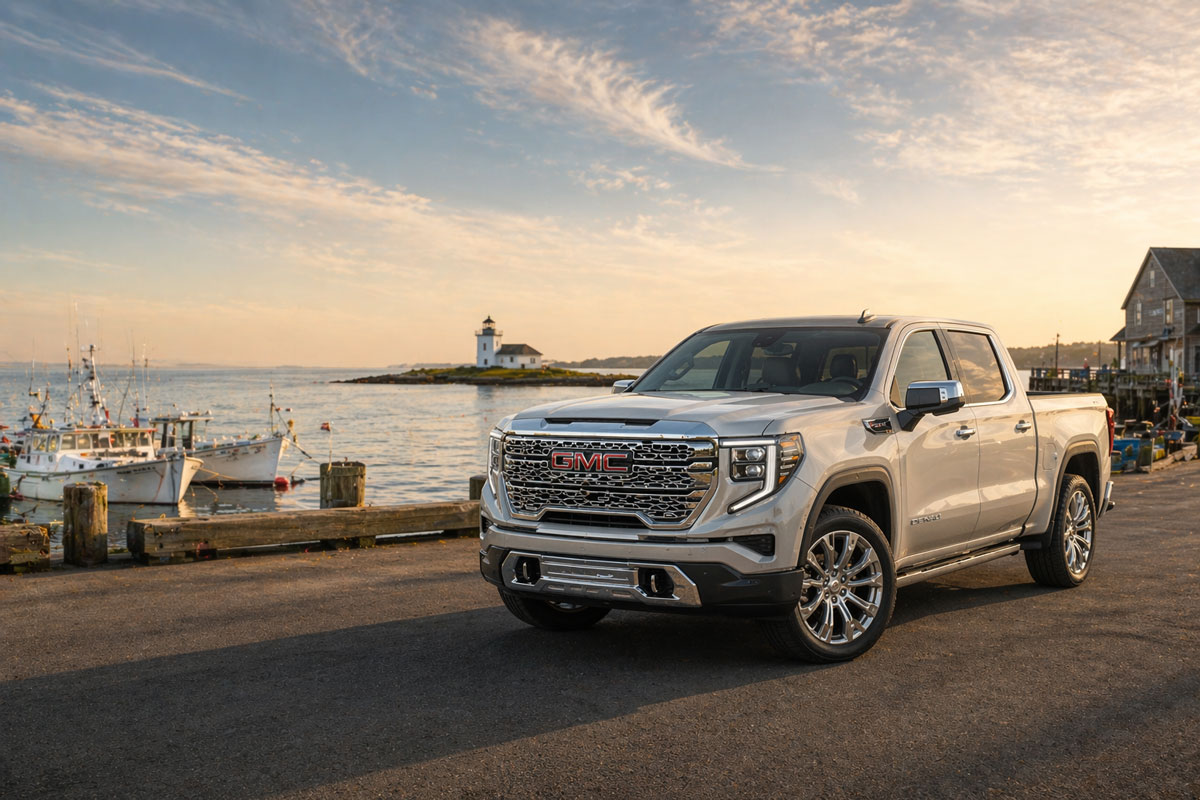
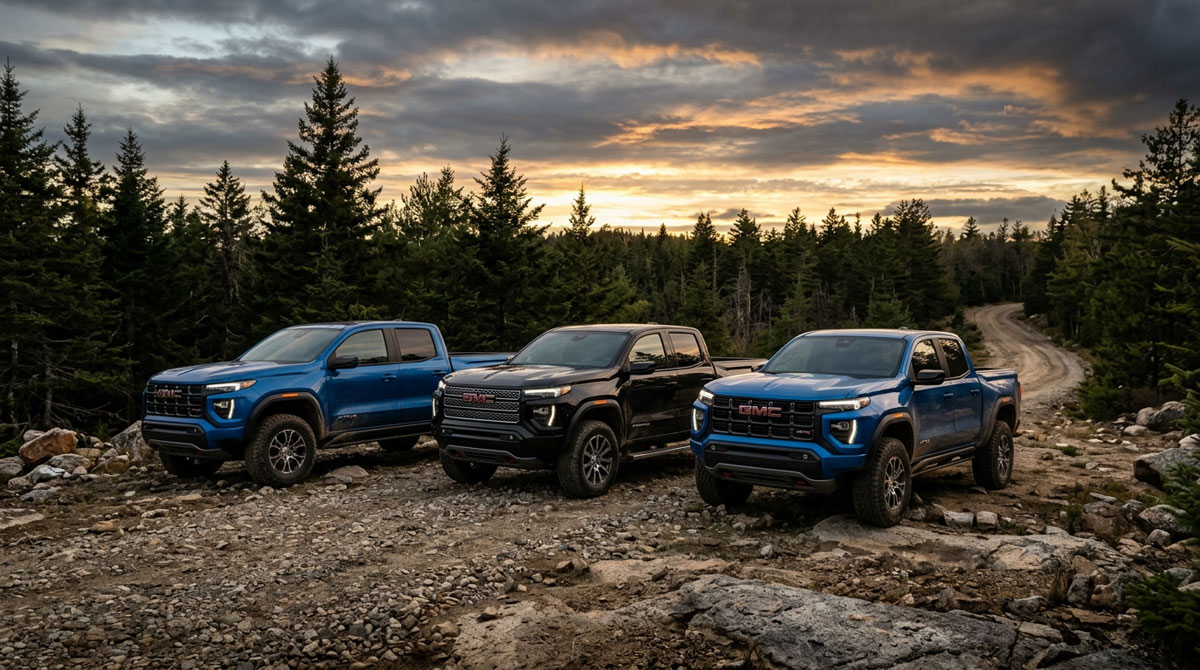
The 2026 GMC Sierra 1500 lineup — both Denali trims available at Weirs GMC in Arundel, ME
The Value Math: Is the Denali Ultimate “Worth It”?
Let’s actually price out the gap. The base Denali at $69,390 plus the options you’d most likely add:
Power sunroof: ~$1,000–$1,500
Super Cruise (with OnStar plan): ~$2,500 + ongoing subscription
Premium audio upgrade: included on both, no add
A well-optioned Denali easily reaches $73,000–$75,000. The Denali Ultimate at $86,190 then represents roughly $11,000 more for: 22-inch wheels (vs. 20-inch), Vader Chrome grille, full-grain leather with plaited stitching, 16-way massage seats, and Centerpoint surround audio.
For some buyers, that $11,000 delta is exactly worth what it buys. For others, it’s $11,000 they’d rather keep. There’s no objectively right answer — it’s a matter of how you weight luxury upgrades against money in the bank.
What We See at Weirs GMC in Arundel
Selling Sierra 1500s in southern Maine for over 65 years has given us a clear view of who buys what. In our market, here’s what we typically see:
Denali buyers tend to be working professionals, contractors at the higher end of their trade, and trade-up buyers from the SLT or Elevation. They want the V8 and the luxury cabin without going to the very top of the price ladder.
Denali Ultimate buyers tend to be established business owners, retirees with discretionary income, second-home owners along the southern Maine coast, and buyers who’ve owned previous Denali Ultimates and won’t go back.
The single most common reason we see Denali buyers later wish they’d gone Ultimate is the massage seats. The single most common reason Ultimate buyers say they’d stay there is everything works together as a complete package — they don’t have to think about which features they have.
If you want to feel the difference yourself, the best move is to drive both back-to-back. Stop by our showroom and we’ll set that up.
Frequently Asked Questions
What is the price difference between the Sierra 1500 Denali and Denali Ultimate?
The 2026 GMC Sierra 1500 Denali starts at $69,390 MSRP. The Denali Ultimate starts at $86,190 MSRP. The price difference is approximately $16,800 before options and packages are factored in. Final pricing depends on configuration and available incentives.
Do the Sierra 1500 Denali and Denali Ultimate have the same engine?
Yes. Both trims come standard with the 6.2L EcoTec3 V8 producing 420 horsepower and 460 lb-ft of torque, paired with the 10-speed automatic transmission. Acceleration, towing capacity (up to 13,100 lbs), and overall performance are identical.
Is Super Cruise standard on the Denali Ultimate?
Yes. Super Cruise hands-free driving technology is standard equipment on the 2026 Sierra 1500 Denali Ultimate, including a 3-year OnStar Connected Services plan. On the standard Denali, Super Cruise is available as an option but not standard equipment.
What size wheels come on the Denali Ultimate?
The 2026 Sierra 1500 Denali Ultimate comes standard with 22-inch Ultra-Bright machined aluminum wheels. The standard Denali uses 20-inch polished aluminum wheels.
Are the seats different between the Denali and Denali Ultimate?
Yes — and this is one of the biggest real-world differences. The Denali offers leather-appointed seats with heating and ventilation. The Denali Ultimate steps up to 16-way power front seats with massage function, finished in full-grain leather with plaited contrast stitching. The materials and adjustability are noticeably more premium in the Ultimate.
Is the Denali Ultimate worth the extra money?
It depends on how much you value the specific upgrades — massage seats, 22-inch wheels, full-grain leather, Vader Chrome grille, standard Super Cruise with included OnStar plan, and standard sunroof. If you would have added Super Cruise and a sunroof to the Denali anyway, the effective price gap shrinks meaningfully. If you wouldn’t, the standard Denali offers most of the luxury experience at a lower price point.
What is Vader Chrome on the Denali Ultimate?
Vader Chrome is a darker, smoke-tinted chrome treatment used on the Denali Ultimate’s grille. It gives the front end a more modern, aggressive look compared to the brighter traditional chrome on the standard Denali. The treatment pairs particularly well with darker paint colors.
Can I drive both trims back-to-back at Weirs GMC?
Yes. We typically stock both Denali and Denali Ultimate inventory at our Arundel location, and we encourage back-to-back test drives — it’s the fastest way to feel the difference between them. Contact our team to confirm specific trims are on the lot before you visit.
See the Denali and Denali Ultimate for Yourself
The right choice between the Denali and Denali Ultimate isn’t about which truck is “better” — they’re both exceptional. It’s about which set of features matches how you’ll actually use the truck and which price point fits your budget.
Stop by our showroom in Arundel, and we’ll walk you through both trims in person. We can pull pricing on what’s currently in stock, run trade numbers, and let you sit in (and drive) both trucks back-to-back. The difference is easier to feel than to read about.
About Weirs GMC: Weirs Motor Sales has been a family-owned GMC dealership in Arundel, Maine for over 65 years, serving Biddeford, Saco, Kennebunk, Kennebunkport, and all of southern Maine. We stock and sell the full Sierra 1500 lineup, with particular depth in the Denali and Denali Ultimate trims our southern Maine customers consistently choose. If you have questions this guide didn’t answer, our team is here to help.
2026 GMC Sierra 1500 Towing Capacity: The Complete Guide
If you’re shopping the 2026 GMC Sierra 1500 with towing in mind, the answer depends entirely on three things: which engine you choose, how the truck is configured, and what you’re actually pulling. Max towing across the lineup ranges from 9,400 pounds with the 2.7L TurboMax up to 13,300 pounds with the 3.0L Duramax diesel — but the real-world numbers most owners care about live somewhere in between.
This guide breaks down every Sierra 1500 engine and configuration, explains the ProGrade Trailering System, and walks through how to calculate your actual towing capacity once you factor in passengers, gear, and trailer weight. We’ve sold and serviced these trucks for over 65 years from our location in Biddeford, Maine — so we’ll also cover the towing scenarios southern Maine owners actually run into.
Quick Answer: Max Towing by Engine
2.7L TurboMax I-4: Up to 9,400 lbs
5.3L EcoTec3 V8: Up to 11,200 lbs
6.2L EcoTec3 V8: Up to 13,100 lbs
3.0L Duramax Turbo-Diesel I-6: Up to 13,300 lbs (max in lineup)
Max Payload: Up to 2,230 lbs (Regular Cab 2WD with TurboMax)
Important: Maximum ratings require specific configurations — usually 2WD, lighter cab/bed combinations, and the Max Trailering Package. Your actual capacity depends on how your truck is built.
2026 Sierra 1500 Towing Capacity Comparison Table
Here’s how the four available engines stack up across the key towing and performance metrics:
Engine
Horsepower
Torque
Max Towing
Transmission
2.7L TurboMax I-4
310 hp
430 lb-ft
9,400 lbs
8-speed automatic
5.3L EcoTec3 V8
355 hp
383 lb-ft
11,200 lbs
8-speed automatic
6.2L EcoTec3 V8
420 hp
460 lb-ft
13,100 lbs
10-speed automatic
3.0L Duramax Diesel I-6
305 hp
495 lb-ft
13,300 lbs
10-speed automatic
The 2026 GMC Sierra 1500 lineup — from the workhorse Pro to the premium Denali
Engine-by-Engine Towing Breakdown
2.7L TurboMax — 9,400 lbs Max Towing
The standard engine on the Pro, SLE, and Elevation trims. The TurboMax delivers 310 horsepower and 430 lb-ft of torque — the highest standard torque in the light-duty truck segment. That torque comes on early in the rev range, which makes it surprisingly capable for everyday towing tasks.
Best for: Single-axle utility trailers, jet skis, smaller boats up to 22 feet, snowmobile trailers, and most landscaping or contractor work where the load stays under 8,500 lbs.
Real-world Maine example: If you’re pulling a 5,000-lb fishing boat from your garage in Saco to the launch at Old Orchard Beach, the TurboMax handles it without breaking a sweat.
5.3L EcoTec3 V8 — 11,200 lbs Max Towing
The most popular engine in the Sierra 1500 lineup for a reason. The 5.3L V8 produces 355 horsepower and 383 lb-ft of torque, paired with the 8-speed automatic. It’s the standard engine on the AT4 and a popular upgrade across the rest of the lineup.
Best for: Mid-size travel trailers and pop-up campers up to 9,500 lbs, larger boats up to 28 feet, equipment trailers carrying a UTV or compact tractor, and most regular weekend towing duties.
Real-world Maine example: Towing a 24-foot travel trailer from Biddeford up to Acadia for a long weekend? The 5.3L V8 has the torque and 8-speed gearing to handle the climbs and the highway speed without issue.
6.2L EcoTec3 V8 — 13,100 lbs Max Towing
The big small-block. 420 horsepower and 460 lb-ft of torque paired with the 10-speed automatic transmission. Standard on the Denali, Denali Ultimate, and AT4X. The 6.2L is the answer when you want strong V8 character, fast acceleration both empty and loaded, and serious towing capacity in one package.
Best for: Large travel trailers up to 12,000 lbs, mid-size fifth-wheels (with proper hitch), bigger boats over 30 feet, car haulers, and equipment trailers carrying tractors or skid steers.
2026 update: The 6.2L V8’s exhaust calibration has been refined for 2026 — there’s a noticeably more aggressive tone in Sport Mode that owners coming from previous model years will pick up immediately.
3.0L Duramax Turbo-Diesel — 13,300 lbs Max Towing
The towing and efficiency champion. 305 horsepower and 495 lb-ft of torque from the inline-six diesel, with up to 23/29 mpg city/highway and the lineup’s highest tow rating at 13,300 lbs. Diesel torque means you barely feel the trailer behind you — and the fuel economy means fewer stops on long hauls.
Best for: Heavy travel trailers, fifth-wheels, large boats, livestock trailers, car haulers, and any towing scenario where you’re putting on serious annual mileage. The diesel’s combined 25 mpg (2WD) makes it the most cost-effective option for owners who tow regularly and rack up miles.
Real-world Maine example: If you’re hauling a 10,000-lb travel trailer from Biddeford to Moosehead Lake every other weekend in summer, the Duramax pays for itself over time in fuel savings while making the 200-mile drive much easier on the truck and the driver.
How to Reach the Sierra 1500’s Maximum Towing Numbers
The headline towing numbers (9,400 / 11,200 / 13,100 / 13,300 lbs) are maximum ratings — they require specific truck configurations. Here’s what it takes to hit each one:
13,300 lbs (Duramax max): Double Cab, 2WD, standard bed, 3.0L Duramax diesel, Max Trailering Package, 20-inch wheels and tires
13,100 lbs (6.2L V8 max): Crew Cab, 2WD, short bed, 6.2L V8, Max Trailering Package
11,200 lbs (5.3L V8 max): Double Cab, 2WD, standard bed, 5.3L V8, Max Trailering Package
9,400 lbs (TurboMax max): Double Cab, 2WD, standard bed, 2.7L TurboMax, Max Trailering Package
Adding 4WD, going to a Crew Cab with the long bed, or skipping the Max Trailering Package will reduce these numbers. Always check the door jamb sticker or the owner’s manual for the specific rating on your truck.
The ProGrade Trailering System
Tow capacity is one thing — being able to use it confidently is another. The Sierra 1500’s available ProGrade Trailering System is one of the most comprehensive trailering tech packages in the segment, and it’s the feature that separates pulling a trailer from actually towing well.
What’s Included
Up to 15 camera views — including hitch guidance, side blind zone, transparent trailer view, and bird’s-eye view of the truck and trailer together
In-Vehicle Trailering App with custom trailer profiles for each trailer you tow
Pre-departure checklists — the truck walks you through verifying lights, brakes, tire pressure, and connections before you leave
Trailer tire pressure monitoring (when equipped) — pulls trailer tire data into the dash display
Jack-knife alert — warns you when the trailer angle gets dangerous
Trailer security alerts — notifies you if the trailer is unhitched without authorization
Hitch guidance with hitch view — lines up the ball with the coupler from the driver’s seat
Why It Matters in Real Towing
If you’ve ever backed a trailer into a tight launch ramp at the Saco River, navigated a narrow campsite at a state park, or hooked up to a trailer alone at sunrise, you know how much time and stress these features save. The transparent trailer view in particular is genuinely useful — it lets you see through the trailer to spot vehicles or obstacles directly behind it.
Real-World Maine Towing Scenarios
Most max-tow numbers are theoretical for most owners. Here’s what actually matters for southern Maine drivers:
Towing a Boat (4,000 – 8,000 lbs)
The vast majority of boats trailered in southern Maine fall in this range — bass boats, center consoles, runabouts, and small cruisers. Any Sierra 1500 engine handles this comfortably. The 5.3L V8 is the sweet spot for most boat owners — strong torque, V8 sound, and headroom for a heavier boat down the road.
Towing a Travel Trailer (5,000 – 10,000 lbs)
Pop-ups and small travel trailers (under 6,000 lbs) work fine with the TurboMax or 5.3L V8. For mid-size travel trailers in the 7,000–10,000 lb range, the 5.3L or 6.2L V8 is the better choice — the extra torque keeps the truck composed on grades like the climb up I-95 toward Bangor.
Towing a Fifth-Wheel
Smaller fifth-wheels under 12,000 lbs can be towed by a properly-equipped Sierra 1500 with the 6.2L V8 or Duramax diesel. For anything heavier, you’re looking at the Sierra 2500 HD instead. Always factor in payload — fifth-wheel pin weight (usually 15-25% of trailer weight) eats into your truck’s payload capacity.
Towing Equipment (Skid Steers, Tractors, UTVs)
An open utility trailer with a compact tractor or two UTVs typically runs 6,000–9,000 lbs total. Any V8 Sierra 1500 handles this. For loaded equipment trailers approaching 12,000 lbs, the 6.2L V8 or Duramax is the right call.
The 2026 GMC Sierra 1500 AT4 — built for Maine’s terrain, from the coast to the White Mountains
How to Calculate Your Actual Towing Capacity
Maximum towing capacity assumes a 150-lb driver and no other passengers, cargo, or accessories. Once you start adding people, gear, and a trailer tongue weight, your usable capacity drops. Here’s the math you actually need:
Key Numbers to Know
GVWR (Gross Vehicle Weight Rating): Max weight of the truck itself — including passengers, cargo, fuel, and tongue weight
GCWR (Gross Combined Weight Rating): Max weight of the truck PLUS the trailer combined
Curb Weight: Weight of the empty truck with fluids, before passengers or cargo
Payload: GVWR minus Curb Weight — what you can put inside the truck (people, cargo, tongue weight)
Tongue Weight: Roughly 10-15% of the trailer weight (or 15-25% for fifth-wheels) — this counts against payload
The Real-World Calculation
Say you have a 6.2L Sierra 1500 Denali Crew Cab with a max tow of 12,500 lbs and a payload of 1,650 lbs. You’re planning to tow a 9,500-lb travel trailer with about 1,000 lbs of tongue weight.
Trailer: 9,500 lbs (well under 12,500 max — good)
Tongue weight: 1,000 lbs (counts against payload)
Driver + passenger: 350 lbs
Gear in cab and bed: 200 lbs
Total payload used: 1,550 lbs (under 1,650 — good)
You’re inside both ratings — you can safely tow this setup. If your trailer were 11,500 lbs with 1,200 lbs of tongue weight, you’d still be under max tow, but you’d exceed payload. That’s where most owners get tripped up.
If you want to verify your specific build, bring your VIN to our service desk at Weirs GMC and we’ll pull the exact ratings off your truck and walk you through the math.
Frequently Asked Questions About Sierra 1500 Towing
How much can a 2026 GMC Sierra 1500 tow?
The 2026 Sierra 1500 tows up to 13,300 pounds when properly equipped with the 3.0L Duramax turbo-diesel engine, 2WD, Double Cab, and standard bed with the Max Trailering Package. Towing capacity ranges from 9,400 lbs (2.7L TurboMax) to 13,300 lbs (Duramax) depending on engine and configuration.
Which Sierra 1500 engine is best for towing?
For maximum towing capacity, the 3.0L Duramax turbo-diesel leads at 13,300 lbs. For maximum power and acceleration while towing, the 6.2L V8 produces 420 hp and tows up to 13,100 lbs. The diesel wins on torque (495 lb-ft) and fuel economy, while the 6.2L V8 wins on horsepower and throttle response.
Can the 2.7L TurboMax tow a travel trailer?
Yes — the 2.7L TurboMax tows up to 9,400 lbs and handles smaller travel trailers (typically under 7,500 lbs gross weight) without issue. Its 430 lb-ft of torque comes on early in the rev range, which makes it surprisingly capable for moderate towing. For larger travel trailers over 8,000 lbs, the 5.3L V8 is a better choice for headroom and long-distance comfort.
What is the difference between max towing and real-world towing?
Max towing assumes a 150-lb driver and no other passengers, cargo, or accessories. Once you add passengers, cargo in the bed or cab, and the trailer tongue weight (which counts against payload), your usable towing capacity drops. Most owners find their real-world capacity is 1,500–2,500 lbs below the maximum rating.
Does the 2026 Sierra 1500 have trailer brake control?
Yes. An integrated trailer brake controller is standard on most Sierra 1500 trims and adjusts the electric brakes on your trailer based on truck deceleration. It’s part of the broader ProGrade Trailering System.
Can the Sierra 1500 tow a fifth-wheel trailer?
Yes, with the proper fifth-wheel hitch installed. Smaller fifth-wheels under 12,000 lbs work with a properly-equipped Sierra 1500 (6.2L V8 or Duramax diesel recommended). For heavier fifth-wheels, look at the Sierra 2500 HD or 3500 HD. Always factor in pin weight (15-25% of trailer weight), which counts against the truck’s payload capacity.
What is the Max Trailering Package on the Sierra 1500?
The Max Trailering Package is a factory option that includes upgraded cooling, a heavy-duty rear axle, the integrated trailer brake controller, hitch guidance, and the in-vehicle trailering app. Most maximum tow ratings require this package — it’s the difference between standard towing and the full advertised capacity.
How do I know my Sierra 1500’s exact towing capacity?
Check the door jamb sticker on the driver’s side, the owner’s manual, or call our service team at Weirs GMC with your VIN. Towing capacity varies based on engine, drivetrain (2WD vs 4WD), cab configuration, bed length, and optional packages — so the number on your specific truck may differ from the lineup maximum.
Find the Right Sierra 1500 for How You Tow
The 2026 GMC Sierra 1500 covers a wide spectrum — from the work-ready Pro pulling a single-axle trailer to the Duramax-equipped Denali hauling a 13,000-lb fifth-wheel. The right truck depends on your specific load, frequency, and how far you’re going.
If you’re not sure which engine and configuration fit your towing needs, stop by our showroom in Biddeford or give us a call. We can walk through the specs, pull the exact ratings on any truck in our inventory, and even hook up your trailer for a real test pull before you buy.
About Weirs GMC: Weirs Motor Sales has been a family-owned GMC dealership in Biddeford, Maine for over 65 years. We sell, service, and tow with Sierra 1500s every day across southern Maine — from Biddeford and Saco out to Kennebunkport, Scarborough, and Old Orchard Beach. If you have a towing question this guide didn’t answer, our team can help.
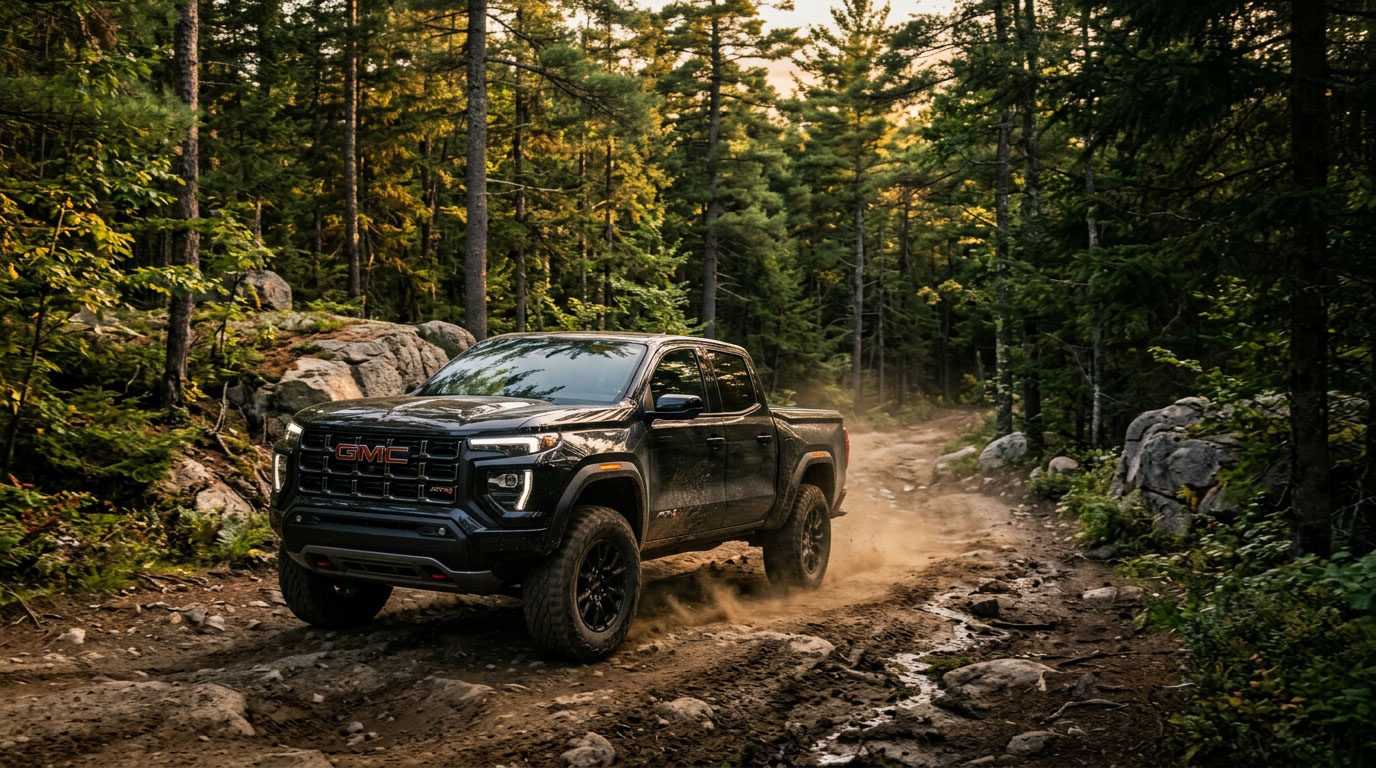
The 2026 GMC Sierra 1500 AT4X — Multimatic DSSV dampers, front and rear locking differentials, and an AEV-designed steel front bumper, photographed on a backcountry logging road in western Maine.
2026 GMC Sierra 1500 AT4 vs. AT4X: Which Off-Road Sierra Is Right for You?
If you’re shopping the 2026 GMC Sierra 1500 with off-road capability in mind, you’ve already narrowed the field to two trims: the AT4 and the AT4X. Both share the same off-road DNA — a factory 2-inch lift, skid plates, hill descent control, and 4WD with a two-speed transfer case. But the AT4X is where GMC took the off-road formula and added serious, race-derived hardware that fundamentally changes what the truck can do.
The price gap is roughly $12,600. The capability gap is bigger than the price suggests — but only if you’ll actually use what the AT4X offers. This guide breaks down every meaningful difference so you can decide which one fits your driving, your terrain, and your budget.
Quick Answer: The Key Differences
Price gap: About $12,600 (AT4 starts at $69,795 / AT4X starts at $82,395)
Standard engine: 5.3L V8 on AT4 / 6.2L V8 on AT4X
Suspension: Rancho shocks (AT4) vs. Multimatic DSSV race-derived dampers (AT4X)
Locking differentials: Rear only (AT4) vs. Front AND rear electronic locking diffs (AT4X)
Front bumper: Standard (AT4) vs. AEV-designed stamped steel with winch prep (AT4X)
Tires: 18-inch all-terrain (AT4) vs. 18-inch with Goodyear Wrangler Territory MT mud-terrain (AT4X)
Front seats: Heated leather (AT4) vs. 16-way power with massage (AT4X)
Both trims share: Factory 2-inch lift, skid plates, hill descent control, 4WD with two-speed transfer case, off-road-tuned suspension geometry, the GMC Pro Safety suite, and the same Crew Cab configuration.
2026 Sierra 1500 AT4 vs. AT4X: Side-by-Side
Here’s how the two off-road trims compare on the features that drive the decision:
Feature
Sierra 1500 AT4
Sierra 1500 AT4X
Starting MSRP
$69,795
$82,395
Standard Engine
5.3L EcoTec3 V8 (355 hp / 383 lb-ft)
6.2L EcoTec3 V8 (420 hp / 460 lb-ft)
Transmission
8-speed automatic
10-speed automatic
Front Suspension Dampers
Rancho monotube
Multimatic DSSV (Dynamic Suspensions Spool Valve)
Rear Suspension Dampers
Rancho monotube
Multimatic DSSV
Locking Differentials
Rear electronic locker
Front AND rear electronic lockers
Factory Lift
2 inches
2 inches
Front Bumper
Standard with red recovery hooks
AEV-designed stamped steel with winch capability
Wheels
18-inch dark-finish aluminum
18-inch AT4X-specific dark-finish aluminum
Tires
All-terrain
Goodyear Wrangler Territory MT (mud-terrain)
Skid Plates
Standard
Standard (heavier-duty)
Front Seats
Leather, heated
16-way power, heated, ventilated, with massage
Hill Descent Control
Standard
Standard
Max Towing
Up to 9,500 lbs
Up to 8,900 lbs
Where the AT4X Earns Its Price
The price gap between the AT4 and AT4X is about $12,600. Here’s exactly what that money buys — and why it matters:
1. Multimatic DSSV Dampers (The Single Biggest Upgrade)
Multimatic DSSV dampers are the suspension hardware that separates a capable off-road truck from a serious one. The technology came from championship-winning race trucks — including the Chevrolet Colorado ZR2, the original DSSV-equipped pickup, and racing applications all the way up to F1.
What they do in plain English: instead of using a single internal valve to control how the shock compresses and rebounds (like a standard monotube damper), DSSV dampers use precisely machined spool valves with multiple chambers. The result is a shock that responds differently at different speeds — soft on small inputs (a washboard logging road) but firm and controlled on big hits (a rock or pothole). The truck stays composed where standard shocks would be bouncing or harsh.
On a paved road, you barely notice them. The moment the surface gets rough, the difference is obvious — the AT4X stays planted while the AT4 starts to feel busy underneath you.
2. Front AND Rear Locking Differentials
Both trucks come with a rear electronic locking differential. The AT4X adds a front locker too. The practical difference: with both axles locked, all four wheels turn at the same speed regardless of traction. If you’re climbing out of a deep mud rut, crossing a fallen tree on a logging road, or working out of a snowbank with one wheel in the air, the front locker is the difference between getting through and getting stuck.
This is the upgrade that matters most for serious off-road use. If you’re driving deep into the western Maine mountains, accessing remote hunting camps, or running technical trails, the front locker is genuinely useful. If you’re on graded gravel and packed snow, you’ll never engage it.
3. AEV-Designed Stamped Steel Front Bumper
American Expedition Vehicles (AEV) is the gold standard in factory and aftermarket off-road truck hardware. The AT4X’s front bumper is a co-developed AEV design — stamped steel construction with built-in winch capability and improved approach angles for rock crawling and steep climbs.
If you ever plan to mount a winch (and on a serious off-road truck you probably should), the AT4X’s bumper is engineered for it from the factory. Adding a winch-rated bumper aftermarket is typically a $2,500–$4,000 upgrade once you factor in the bumper, mount kit, and installation.
4. 6.2L V8 Standard
The AT4 starts with the 5.3L V8. The AT4X comes standard with the 6.2L V8 and the 10-speed automatic transmission. That’s 65 more horsepower and 77 more lb-ft of torque, plus better gear spacing for both off-road crawling and highway acceleration. If you wanted the 6.2L on the AT4, it’s a roughly $3,000+ option — so part of the AT4X’s price gap is the engine upgrade you’d likely add anyway.
5. Goodyear Wrangler Territory MT Tires
The AT4 comes on all-terrain tires — a balanced choice that works fine on pavement and adequately off-road. The AT4X comes on Goodyear Wrangler Territory MT (mud-terrain) tires, which have larger tread blocks, more aggressive sidewall design, and significantly more grip in mud, sand, deep snow, and loose surfaces. The trade-off is more road noise on pavement and slightly worse fuel economy. For a truck that will see real off-road duty, that trade is worth it.
6. 16-Way Power Seats with Massage
This is the Denali-grade upgrade you don’t expect on an off-road trim. The AT4X gets the same 16-way power-adjustable, heated, ventilated, massage-equipped front seats found in the Denali Ultimate. After a long day on rough trails or a 5-hour drive home from a hunting camp, the seats are not just a luxury — they’re a meaningful comfort and recovery feature.
Where the Standard AT4 Holds Its Ground
The AT4X gets the headlines, but the AT4 is a genuinely capable truck — and for the majority of buyers, it’s the right choice. Here’s what the AT4 brings to the table:
Same factory 2-inch lift, same 4WD system. The truck sits at the same height and engages 4Hi/4Lo the same way.
Same hill descent control and skid plate protection. The undercarriage is protected for trail driving.
5.3L V8 is more than capable. 355 hp and 383 lb-ft is plenty of power for daily driving, towing under 9,500 lbs, and any off-road scenario short of serious rock crawling.
Higher towing capacity. The AT4 actually tows slightly more than the AT4X (9,500 lbs vs 8,900 lbs) thanks to its lighter overall weight and different gear ratios.
Less aggressive tires = better daily driving. The all-terrain tires are quieter on pavement, get better fuel economy, and last longer than the AT4X’s mud-terrains. For a daily driver that occasionally goes off-pavement, this is the better tire choice.
$12,600 stays in your pocket. That’s a meaningful difference — enough for a winch, a bed cover, a roof rack, premium tires, and accessories with money left over.
The AT4 handles Maine winters confidently with its standard 4WD, factory lift, and all-terrain tires — well-suited for daily driving across southern Maine.
Who Should Buy the AT4, and Who Should Step Up to the AT4X
Buy the Sierra 1500 AT4 if…
You want off-road capability for occasional use — graded gravel roads, packed snow, light trail riding, hunting access on maintained roads
You’ll spend most of your time on pavement and want a truck that drives well there
The 5.3L V8 makes sense for your towing and daily driving needs (under 9,500 lbs)
You don’t need front-axle locking and probably won’t run a winch
You appreciate the off-road styling and stance but won’t push the truck to its mechanical limits
Budget matters and you’d rather put $12,600 toward accessories, fuel, or trade equity
Step up to the Sierra 1500 AT4X if…
You’ll genuinely use the truck off-pavement on a regular basis — backcountry logging roads, rough trails, deep snow, mud
You want or plan to add a winch (the AEV bumper is built for it)
You drive long distances and want the massage seats — they’re a real comfort feature on 4-hour-plus drives
You want the 6.2L V8 standard rather than as an option
You value the Multimatic DSSV ride quality on rough surfaces — once you’ve felt it, standard shocks feel less composed
You buy the best version of vehicles you keep long-term and won’t second-guess the decision later
Real-World Maine Off-Road Scenarios
Here’s how each trim performs in the situations southern Maine buyers actually run into:
Accessing a Remote Hunting Camp in Western Maine
If your camp is at the end of a maintained gravel road, the AT4 handles it with zero issue — even after rain, mud, or moderate snow. If your camp is at the end of an unmaintained logging road that gets washed out, has deep ruts, or requires crossing rough terrain, the AT4X’s locking diffs and DSSV dampers make a real difference. For most southern Maine hunters accessing camps in the Bethel, Rangeley, or Mahoosuc area, the AT4 is the practical choice. For deep-woods camps requiring legitimate trail driving, the AT4X earns its price.
Maine Winter Driving
For everyday winter driving across southern Maine — Arundel, Biddeford, Saco, Kennebunk, Scarborough — the AT4 is excellent. Standard 4WD, factory lift, all-terrain tires, and hill descent control handle ice, snow, and slush. The AT4X’s mud-terrain tires are actually worse in snow than dedicated winter tires (and only marginally better than the AT4’s all-terrains), so the AT4 is often the better daily winter driver. If you commute or drive long distances daily, lean AT4.
Towing a Snowmobile or Boat to Remote Trails / Launches
Both trims tow comfortably under 9,000 lbs — covering most snowmobile trailers, mid-size boats, and ATV trailers. The AT4 actually has slightly higher max towing (9,500 vs. 8,900 lbs). If you’re regularly towing toward the upper end of those numbers, the AT4 has a small edge.
Beach Access (where allowed)
The AT4X’s mud-terrain tires and front locker shine in soft sand. The AT4 with all-terrains can handle harder packed sand but will get stuck in soft conditions where the AT4X would walk through. If beach driving is part of your use, lean AT4X.
Crawling Technical Trails
If you’re running real off-road trails with rocks, ledges, and significant articulation requirements, the AT4X is the right truck. The AT4 will struggle in scenarios the AT4X handles confidently. This is the use case where the AT4X earns every dollar of its premium.
The Value Math: Is the AT4X Worth $12,600 More?
Let’s price out what the AT4X effectively gives you over a similarly-equipped AT4:
Mud-terrain tire upgrade: ~$1,200–$1,800 for a set
Multimatic DSSV dampers retrofit: Not available aftermarket — DSSV dampers are factory-installed only on the AT4X
Front locking differential: Aftermarket installation runs $2,500–$5,000+ and voids portions of the warranty
16-way massage seats: Not available as an aftermarket retrofit
Add up just the upgrades you could actually do aftermarket — engine, bumper, tires — and you’re at roughly $7,000–$8,800 in retrofit costs to a base AT4, and you still don’t have the DSSV dampers, front locker, or massage seats. From a pure value standpoint, if you’d want any of the AT4X’s signature features, the AT4X is the better buy. If you’d be happy with the AT4 as-equipped from the factory, the savings are real.
What We See at Weirs GMC in Arundel
Selling Sierra 1500s across southern Maine for over 65 years, here’s the pattern we typically see between AT4 and AT4X buyers in our market:
AT4 buyers tend to be year-round daily drivers who want capability for Maine winters and occasional camping or hunting access. They use 4WD often, but rarely engage anything more aggressive than 4Hi.
AT4X buyers tend to be serious outdoor enthusiasts — buyers who own waterfront property at the end of a long unmaintained road, hunters with deep-woods camps, off-road hobbyists, or buyers who simply want the most capable Sierra 1500 built and don’t want to compromise.
The single most common “I should have gone AT4X” moment we hear from AT4 owners is when they get to a situation they could have handled with the front locker. The single most common reason AT4X owners stay there is they like knowing they have the capability whether or not they use it every day.
If you’re unsure which one fits, the best move is to drive both back-to-back. Stop by our showroom in Arundel and we’ll set that up — and we can take both trucks onto rougher surfaces so you can feel the difference in suspension behavior firsthand.
Frequently Asked Questions
What is the price difference between the Sierra 1500 AT4 and AT4X?
The 2026 GMC Sierra 1500 AT4 starts at $69,795 MSRP. The AT4X starts at $82,395 MSRP. The price difference is approximately $12,600 before options and packages are factored in.
What is the main difference between the AT4 and AT4X?
The biggest mechanical differences are the suspension dampers (Rancho on the AT4 vs. Multimatic DSSV on the AT4X), the locking differentials (rear-only on the AT4 vs. front and rear on the AT4X), the standard engine (5.3L V8 on the AT4 vs. 6.2L V8 on the AT4X), and the front bumper (standard on the AT4 vs. AEV-designed steel with winch capability on the AT4X). The AT4X is built for serious off-road use; the AT4 is built for capable daily driving with light-to-moderate off-road duty.
What are Multimatic DSSV dampers?
Multimatic DSSV (Dynamic Suspensions Spool Valve) dampers are race-derived shock absorbers that use precisely machined spool valves instead of traditional internal valving. They provide better control across a wider range of impacts — soft on small bumps and washboard surfaces, firm and controlled on large hits like rocks or potholes. The technology comes from championship-winning off-road racing applications and is exclusive to the AT4X in the Sierra 1500 lineup.
Does the AT4X have a front locking differential?
Yes. The 2026 Sierra 1500 AT4X has electronic locking differentials on both the front and rear axles. The standard AT4 has a rear locking differential only. The front locker provides a major capability advantage in serious off-road scenarios where wheel articulation causes traction loss — like crossing rough terrain, climbing out of ruts, or working around obstacles.
Can the AT4X tow as much as the AT4?
The AT4 actually has slightly higher max towing capacity at 9,500 lbs vs. the AT4X at 8,900 lbs. The AT4X’s heavier curb weight (due to the AEV bumper, DSSV dampers, and other off-road hardware) and different gearing reduce its tow rating slightly. For most owners, both numbers are well within their actual towing needs.
Are the AT4X’s mud-terrain tires good for Maine winter driving?
Mud-terrain tires perform well in deep snow but are actually less effective on ice and packed snow than the AT4’s all-terrain tires or dedicated winter tires. For drivers whose primary need is winter daily driving in southern Maine, the AT4 with all-terrain tires (or the AT4X with a separate set of winter tires) is often the better choice. The AT4X’s mud-terrains are best for off-road use where deep snow, mud, and loose surfaces are common.
Can I install a winch on the AT4 instead of buying the AT4X?
You can install an aftermarket winch-rated bumper and winch on the AT4, but the cost typically runs $2,500–$4,000 in parts and installation, and the result still won’t include the AT4X’s DSSV dampers, front locker, or AEV engineering. If a winch is essential to your use, the AT4X is the more cost-effective and warranty-friendly choice.
Does the AT4X have luxury interior features?
Yes. The AT4X comes with 16-way power-adjustable front seats featuring heating, ventilation, and massage — the same seats found in the Denali Ultimate. Other interior upgrades include premium materials, the 13.4-inch Google Built-In touchscreen, and Bose audio. It’s effectively a luxury-spec interior in an off-road-spec truck.
Can I drive both trims back-to-back at Weirs GMC?
Yes. We typically stock both AT4 and AT4X inventory at our Arundel location, and back-to-back test drives are the fastest way to feel the suspension and capability differences. Contact our team to confirm specific trims are on the lot before you visit.
Find the Right Off-Road Sierra for Your Maine Adventures
The right choice between the AT4 and AT4X comes down to a single question: how often will you actually use serious off-road capability? If the answer is “regularly, in genuinely rough terrain,” the AT4X is engineered for exactly that. If the answer is “occasionally, on graded surfaces and in winter conditions,” the AT4 will serve you well and save you $12,600.
Stop by our showroom in Arundel and we’ll walk you through both trims in person. We can pull current inventory, run trade numbers, and let you compare the two trucks side-by-side — including a back-to-back drive on rougher surfaces if you want to feel the suspension difference yourself.
About Weirs GMC: Weirs Motor Sales has been a family-owned GMC dealership in Arundel, Maine for over 65 years, serving Biddeford, Saco, Kennebunk, Kennebunkport, and all of southern Maine. We stock the full Sierra 1500 lineup with particular depth in the AT4 and AT4X off-road trims our southern Maine customers consistently choose for year-round capability. If you have questions this guide didn’t answer, our team is here to help.
The 2026 GMC Sierra 1500 offers four engines — the 2.7L TurboMax, 5.3L V8, 6.2L V8 (shown), and 3.0L Duramax turbo-diesel — each suited to a different kind of driver.
Best Engine for the 2026 GMC Sierra 1500: TurboMax vs. V8 vs. Duramax Diesel
Of every decision you’ll make when ordering a 2026 GMC Sierra 1500 — trim, cab, bed, color, options — the engine choice has the biggest impact on how the truck actually drives, what it can pull, what it costs to fuel, and how it holds value over time. GMC offers four powertrains across the lineup, and each one suits a different kind of driver.
This guide walks through all four — the 2.7L TurboMax, 5.3L V8, 6.2L V8, and 3.0L Duramax diesel — with real-world performance characteristics, fuel cost comparisons over 15,000 miles per year, and clear recommendations for who should pick each one. We’ve sold and serviced these trucks for over 65 years from our location in Arundel, Maine, so we’ll also cover what we see local buyers actually choose and why.
Quick Answer: Which Engine Should You Pick?
Daily driver, light hauling, value: 2.7L TurboMax (best efficiency-to-capability ratio in the lineup)
All-around best balance for most buyers: 5.3L EcoTec3 V8 (the most popular choice for a reason)
Maximum power, V8 character, heavy towing: 6.2L EcoTec3 V8 (420 hp, 13,100 lbs towing)
Maximum towing AND best fuel economy: 3.0L Duramax turbo-diesel (13,300 lbs towing, 29 highway mpg)
High-mileage owner who tows regularly: 3.0L Duramax (pays for itself over time in fuel savings)
2026 Sierra 1500 Engine Comparison Table
Here’s how the four available engines compare on the metrics that drive the buying decision:
Engine
HP
Torque
Trans
Max Tow
MPG (City/Hwy 2WD)
2.7L TurboMax I-4
310
430 lb-ft
8-spd
9,400 lbs
19 / 22
5.3L EcoTec3 V8
355
383 lb-ft
8-spd
11,200 lbs
16 / 21
6.2L EcoTec3 V8
420
460 lb-ft
10-spd
13,100 lbs
15 / 20
3.0L Duramax Diesel I-6
305
495 lb-ft
10-spd
13,300 lbs
23 / 29
Deep Dive: All Four Engines
2.7L TurboMax Turbocharged Four-Cylinder
The numbers: 310 hp, 430 lb-ft of torque, 8-speed automatic, up to 9,400 lbs towing, 19/22 mpg.
What it’s like to drive: The TurboMax doesn’t sound like a truck engine, but it pulls like one. Its 430 lb-ft of torque arrives early in the rev range — most of it available by 1,500 RPM — which gives it the responsive throttle feel that matters most in daily driving. From a stop, it accelerates more like a small SUV than a half-ton truck, which is the point.
Where it fits in the lineup: Standard on the Pro, SLE, and Elevation trims. This is the engine GMC built to be the new “default” for buyers who don’t need a V8 but won’t accept underpowered. It delivers the highest standard torque in the light-duty truck segment.
Strengths: Best fuel economy of any gas Sierra (only the diesel beats it). Best torque-to-displacement ratio in the lineup. Lower MSRP than V8 options. Quieter at cruise. Modern technology — direct injection, variable valve timing, active fuel management.
Weaknesses: No V8 sound or character. Tow rating tops out at 9,400 lbs, which limits heavy hauling. Some buyers still aren’t comfortable with a four-cylinder in a full-size truck — fair or not.
Best for: Daily drivers, contractors who tow under 8,500 lbs occasionally, fleet buyers, and anyone whose primary need is getting good fuel economy in a truck that still hauls and tows competently.
5.3L EcoTec3 V8
The numbers: 355 hp, 383 lb-ft of torque, 8-speed automatic, up to 11,200 lbs towing, 16/21 mpg.
What it’s like to drive: The 5.3L V8 is the engine most people picture when they think “Sierra 1500.” It has the deep V8 sound, the smooth power delivery, and the unmistakable character that makes a full-size truck feel like one. Power builds steadily across the rev range — not as immediate as the TurboMax’s torque, but more linear and satisfying.
Where it fits in the lineup: Available across most trims and standard on the AT4. The 5.3L has been GMC’s volume V8 for over a decade, and it’s the engine our customers most often choose when they want a V8 without going all the way to the 6.2L.
Strengths: Proven reliability — millions of miles of real-world data. The classic V8 sound and feel. Strong towing for the price (11,200 lbs handles the vast majority of trailers). Active fuel management improves cruise economy.
Weaknesses: 2-3 mpg worse than the TurboMax. The 8-speed (rather than 10-speed) means slightly less precise gear matching at highway speeds.
Best for: Buyers who want a V8 truck for the right reasons — sound, character, proven longevity, and capable towing. The most popular engine in the lineup, and for most buyers, the right answer.
For a deeper comparison between the 2.7L TurboMax and the 5.3L V8 specifically, see our existing post: 2.7L TurboMax vs. 5.3L V8.
6.2L EcoTec3 V8
The numbers: 420 hp, 460 lb-ft of torque, 10-speed automatic, up to 13,100 lbs towing, 15/20 mpg (2WD).
What it’s like to drive: The 6.2L V8 is the most powerful engine in the Sierra 1500 lineup, and it feels like it. 0-60 acceleration is faster than most people expect from a full-size truck — well under 6 seconds in lighter configurations. The 10-speed automatic is paired specifically to make the most of the 6.2L’s broad power band, with closer gear ratios that keep the engine in its sweet spot whether you’re accelerating from a stop or passing on the highway.
What changed for 2026: The exhaust calibration has been refined for 2026 — there’s a noticeably more aggressive tone in Sport Mode that owners coming from earlier model years will pick up immediately. It’s still subtle enough to keep the truck civilized, but it adds character.
Where it fits in the lineup: Standard on the Denali, Denali Ultimate, and AT4X. Available on other trims as an upgrade. The 6.2L is the engine for buyers who want the full V8 experience without compromise.
Strengths: The most horsepower in the lineup. The most aggressive sound (especially after the 2026 exhaust update). 10-speed automatic provides better gearing precision than the 8-speed. Strong towing power, fast acceleration both empty and loaded.
Weaknesses: Lowest gas-engine fuel economy. Higher upfront cost vs. the 5.3L. Requires premium fuel for max performance (regular is acceptable, but power and economy take a small hit).
Best for: Buyers who want maximum performance from a gas engine, value V8 character above all else, regularly tow heavy loads (10,000-13,100 lbs), or are buying the Denali / Denali Ultimate / AT4X where it’s standard.
3.0L Duramax Turbo-Diesel Inline-Six
The numbers: 305 hp, 495 lb-ft of torque, 10-speed automatic, up to 13,300 lbs towing, 23/29 mpg (2WD).
What it’s like to drive: The Duramax diesel feels different from any of the gas options — quieter than you’d expect, smoother than older diesels, and with a torque curve that makes towing feel almost effortless. Most of the 495 lb-ft is available below 2,000 RPM, which means the engine barely works under normal driving and pulls heavy loads without strain. On the highway empty, it sips fuel at remarkable rates for a full-size truck.
Where it fits in the lineup: Available across most trims as an upgrade option. The Duramax is the choice for buyers who run high annual mileage, tow heavy loads regularly, or simply want the most fuel-efficient version of the truck.
Strengths: Highest tow rating in the lineup (13,300 lbs). Highest torque output (495 lb-ft). Significantly better fuel economy than any gas engine — especially on the highway. Quieter and smoother than diesel buyers expect. Long-term durability of the inline-six diesel architecture is well-proven.
Weaknesses: Higher upfront cost ($3,000-$4,000 over the gas options). Diesel fuel currently runs higher per gallon than regular gasoline. Diesel-specific maintenance items (DEF refill, fuel filter intervals) add cost over time. Cold weather requires longer warm-up — though modern diesels handle Maine winters well.
Best for: Frequent tow vehicles (boats, campers, fifth-wheels), high-mileage drivers (15,000+ miles per year), buyers who do a lot of highway driving, and anyone who values long-term operating cost over upfront cost.
The 2026 Sierra 1500 hauls a boat on the Saco River — proof that the right engine makes all the difference in Maine.
Fuel Cost Comparison: 15,000 Miles Per Year
One of the easiest ways to compare engines is to look at what they actually cost to fuel over a year of typical driving. The math below assumes 15,000 miles per year, mixed driving (60% highway / 40% city), gasoline at $3.40/gallon, and diesel at $3.80/gallon (rough April 2026 averages — adjust for your local prices).
Engine
Combined MPG
Gallons / Year
Annual Fuel Cost
vs. 5.3L V8
2.7L TurboMax
~20 mpg
750
$2,550
– $385/year
5.3L V8
~18 mpg
833
$2,832
baseline
6.2L V8
~17 mpg
882
$3,000
+ $168/year
3.0L Duramax Diesel
~25 mpg
600
$2,280
– $552/year
Over five years of ownership, the Duramax diesel saves roughly $2,760 in fuel costs vs. the 5.3L V8 — even with diesel priced higher per gallon. That savings grows for high-mileage drivers and shrinks for low-mileage owners.
The break-even math on diesel: If the Duramax option adds about $4,000 to the price vs. the 5.3L V8, you’d recover that premium in fuel savings at roughly 7-8 years of typical driving — or 4-5 years if you put on 25,000+ miles annually. Add diesel’s higher resale value and longer engine life and the math gets better.
Real-World Maine Driving Scenarios
Specs and fuel cost tables matter, but most buyers really want to know: which engine fits how I actually drive? Here’s the breakdown for common southern Maine use patterns:
Daily Commuter — Arundel to Portland and Back
If your daily driving is mostly highway and your towing needs are minimal, the 2.7L TurboMax is the value choice. You’ll save 4-5 mpg over the 5.3L V8 on this drive, and the engine is more than capable for the speeds and demands involved. The 5.3L V8 is the right answer if you simply want the V8 sound and don’t mind paying a few hundred dollars more in fuel per year.
Weekend Camper Tower — Saco to White Mountains or Bar Harbor
For travel trailers in the 6,000–9,000 lb range, the 5.3L V8 is the classic choice — strong enough to pull confidently, smooth enough for long highway hauls. For larger trailers (9,000+ lbs) or for owners who tow several times per month, the 6.2L V8 or Duramax diesel is the better long-term call.
Boat Owner — Trailer Boats from 5,000 to 8,000 lbs
Most southern Maine boats trailered to local launches fall in this range. Any V8 handles it comfortably. The 5.3L is the smart pick — capable, characterful, and reasonably priced. The 6.2L is the right call if you ever plan to upgrade to a larger boat.
Contractor / Fleet Use — Daily Hauling Around the Job Site
For trades and contractors carrying tools and materials but not towing heavy daily, the 2.7L TurboMax is genuinely the best fit. Lower upfront cost, lower fuel cost, and the torque comes on early enough that loaded the truck still feels responsive.
High-Mileage Driver — 25,000+ Miles Per Year, Frequent Towing
This is exactly what the 3.0L Duramax diesel was built for. The fuel savings add up quickly at this mileage, and the engine’s long-term durability means you’re not worried about wear at 150,000+ miles. If you’re racking up serious miles and pulling regularly, the diesel pays for itself faster than most buyers expect.
If you’re buying an AT4 or AT4X, the engine choice is partially made for you (5.3L standard on AT4, 6.2L standard on AT4X). For trail driving and camp access, the 6.2L’s extra torque and the 10-speed’s lower crawl gearing are useful. For most other buyers, the standard engines work fine.
The Decision Framework: Three Questions to Ask
Cut through the spec sheets with three honest questions:
1. How much do you tow, and how heavy?
Rarely / under 8,500 lbs: TurboMax
Occasionally / 8,500-10,500 lbs: 5.3L V8
Frequently / 10,500-13,100 lbs: 6.2L V8
Frequently / 13,000+ lbs or pulling for long distances: Duramax diesel
2. How many miles do you drive per year?
Under 12,000 miles: Fuel economy matters less. Pick the engine you want for sound and capability.
12,000-20,000 miles: Fuel cost gap between TurboMax and 6.2L V8 is meaningful (~$500/year). Worth weighing.
20,000+ miles: Diesel fuel savings get significant. Strongly consider the Duramax.
3. How much does V8 character matter to you?
Doesn’t matter / I just want a capable truck: TurboMax or Duramax
Matters somewhat / I want a V8 but don’t need maximum power: 5.3L V8
Matters a lot / I want the strongest, best-sounding engine: 6.2L V8
The full 2026 Sierra 1500 lineup at Portland Jetport — every trim, every engine option, ready to test drive at Weirs GMC in Arundel.
What We See at Weirs GMC in Arundel
Selling Sierra 1500s across southern Maine for over 65 years, here’s the engine breakdown we typically see in our market:
5.3L V8 is by far the most popular engine choice. It’s the default V8 truck for most southern Maine buyers — strong enough for nearly any task, with the V8 sound and proven track record.
2.7L TurboMax wins over a meaningful number of buyers each year, especially Pro and SLE customers, fleet buyers, and anyone whose primary need is daily driving with light towing.
6.2L V8 is essentially standard equipment in our market — it comes built into the Denali, Denali Ultimate, and AT4X trims that move strongly here. Buyers who specifically choose the 6.2L over the 5.3L are usually doing so for towing or because they want the strongest gas engine available.
3.0L Duramax diesel is the most underrated choice in our market. It tends to be picked by serious tow-vehicle buyers, high-mileage drivers, and owners who’ve had diesels before and won’t go back to gas.
If you want help picking the right engine for how you actually drive, stop by our Arundel showroom. We’ll walk through your specific use case and help you avoid both over-buying (paying for capability you’ll never use) and under-buying (regretting your engine choice the first time you try to tow).
Frequently Asked Questions
What is the most fuel-efficient engine in the 2026 Sierra 1500?
The 3.0L Duramax turbo-diesel is the most fuel-efficient engine in the lineup, achieving up to 23 mpg city / 29 mpg highway in 2WD configurations. Among gas engines, the 2.7L TurboMax leads with up to 19/22 mpg in 2WD.
Is the 2.7L TurboMax really powerful enough for a full-size truck?
Yes. The 2.7L TurboMax produces 310 horsepower and 430 lb-ft of torque — the highest standard torque in the light-duty truck segment. Most of that torque is available by 1,500 RPM, so the engine feels responsive in everyday driving and tows up to 9,400 lbs comfortably. It’s not the right choice for heavy regular towing, but for daily driving and light hauling it’s more than capable.
Should I choose the 5.3L V8 or the 6.2L V8?
The 5.3L V8 (355 hp / 383 lb-ft) is the right choice for most V8 buyers — it has the V8 sound and character, tows up to 11,200 lbs, and costs less than the 6.2L. The 6.2L V8 (420 hp / 460 lb-ft) is worth the upgrade if you tow regularly above 10,000 lbs, want maximum acceleration, or are buying a Denali / Denali Ultimate / AT4X where it’s standard. The 6.2L also pairs with the 10-speed automatic for better gearing precision.
Is the Duramax diesel worth the extra cost?
It depends on how many miles you drive and how much you tow. The Duramax option typically adds $3,000-$4,000 over the gas engines, but it returns roughly $500-$700 per year in fuel savings vs. the 5.3L V8 at average mileage. Break-even runs about 7-8 years for typical drivers, or 4-5 years for high-mileage owners (25,000+ miles per year). Diesel also has higher resale value, longer engine life, and stronger towing capacity (13,300 lbs max).
Which Sierra 1500 engine is best for towing?
For maximum towing capacity, the 3.0L Duramax diesel leads at 13,300 lbs. For towing combined with strong acceleration and V8 power, the 6.2L V8 tows up to 13,100 lbs. The diesel wins on torque (495 lb-ft) and fuel economy while towing. The 6.2L V8 wins on horsepower and throttle response. For lighter towing, the 5.3L V8 (11,200 lbs) and 2.7L TurboMax (9,400 lbs) are both capable choices.
Does the 6.2L V8 require premium fuel?
The 6.2L V8 is recommended to run on premium fuel for optimal performance, but it can run on regular gasoline. Using regular fuel results in a small reduction in horsepower and fuel economy but does not damage the engine. Most owners run premium when towing or under heavy load, and regular for daily driving.
How does the Duramax handle Maine winters?
Modern diesels — including the 3.0L Duramax — handle cold weather well thanks to glow plug systems, block heaters, and modern fuel formulations. In sub-zero Maine temperatures, you’ll want to plug in the block heater overnight for easier starts and faster cabin warm-up, but the engine itself is well-suited to winter use. Many high-mileage Maine drivers run diesels year-round without issues.
Which engines come standard on each trim?
The 2.7L TurboMax is standard on the Pro, SLE, and Elevation trims. The 5.3L V8 is standard on the AT4. The 6.2L V8 is standard on the Denali, Denali Ultimate, and AT4X. The 3.0L Duramax diesel is available across most trims as an option. Engine availability varies by configuration — contact our team at Weirs GMC for specifics on any build.
Pick the Right Engine — Then Stop By and Drive It
Reading specs only gets you so far. Each of these engines has its own personality, and the only real way to know which one fits you is to drive it. We typically have all four powertrains represented on our Arundel lot at any given time, and we’re happy to set up back-to-back drives so you can feel the difference between, say, the TurboMax and the 5.3L V8, or the 5.3L V8 and the Duramax diesel.
If you’d like help thinking through your specific use case before you visit, give us a call. Most of the time we can recommend the right engine in a 5-minute conversation.
About Weirs GMC: Weirs Motor Sales has been a family-owned GMC dealership in Arundel, Maine for over 65 years, serving Biddeford, Saco, Kennebunk, Kennebunkport, and all of southern Maine. We sell and service every Sierra 1500 engine option, and our team can help you choose the right one for how you actually drive. If you have engine questions this guide didn’t answer, we’re here to help.
Towing a Boat with the GMC Sierra 1500: A Maine Owner’s Guide
If you own a boat in southern Maine, your truck does as much real work in May through October as it does the rest of the year combined. Hauling from the garage to the launch, navigating tight ramps at low tide, backing carefully into the water with a $40,000+ boat behind you — boat towing is one of the most demanding things you’ll ask your truck to do.
The good news: a properly-configured 2026 GMC Sierra 1500 handles nearly every boat trailered in Maine. The right engine and equipment depend on your boat’s weight, where you launch, and how often you tow. This guide walks through engine selection by boat class, the ProGrade Trailering System features that matter most at the ramp, specific Maine launch tips, and the pre-launch checklist we recommend to every boat-owner customer at our Arundel showroom.
Quick Answer: Best Sierra 1500 Engine by Boat Weight
Bass boats / runabouts under 4,000 lbs: Any engine (2.7L TurboMax is more than enough)
Center consoles / pontoons 4,000–8,000 lbs: 5.3L V8 is the sweet spot
Cruisers / sport boats 8,000–10,000 lbs: 5.3L V8 (with headroom) or 6.2L V8
Heaviest hauls or frequent long-distance towing: 3.0L Duramax diesel (max 13,300 lbs towing, best fuel economy)
Always remember: Boat weight is just part of the equation. Trailer weight, fuel, gear, and tongue weight all factor in — see the weight calculation section below.
Engine Selection by Boat Weight Class
Boat marketing weights are usually “dry weight” — the boat alone, no fuel, no gear, no trailer. Real-world towed weight is typically 30-50% higher once you add the trailer, fuel, batteries, ice, gear, and water in the bilge. Here’s how that plays out across boat categories common in Maine waters:
Bass Boats and Small Runabouts (Under 4,000 lbs Towed Weight)
Examples: 16-19 ft bass boats, jet skis on dual trailers, small aluminum fishing boats, Boston Whaler Montauks. Recommended engine: Any Sierra 1500 engine. The 2.7L TurboMax (310 hp / 430 lb-ft, 9,400 lbs max towing) handles this category effortlessly. Trim recommendation: Pro, SLE, Elevation — no need to step up for towing alone.
You’ll barely notice the boat behind you with any of these setups. The TurboMax’s 430 lb-ft of torque arrives at low RPM, which makes pulling out of launches and merging onto Route 1 feel responsive even with the boat in tow.
Center Consoles, Pontoons, and Mid-Size Boats (4,000–8,000 lbs Towed Weight)
Examples: 20-23 ft center consoles, 22-24 ft pontoon boats, mid-size walkarounds, classic runabouts. Recommended engine: 5.3L V8 is the sweet spot — 355 hp / 383 lb-ft / 11,200 lbs max towing. Plenty of headroom for the load. Trim recommendation: SLT, AT4, or any V8-equipped trim.
This is the largest single category of boats trailered in southern Maine, and it’s exactly what the 5.3L V8 was designed for. The V8 sound and torque make highway hauls comfortable, and the 11,200-lb capacity gives you significant safety margin even loaded with passengers and gear.
Cruisers, Cuddy Cabins, and Large Sport Boats (8,000–10,000 lbs Towed Weight)
Examples: 25-28 ft cabin cruisers, larger center consoles with twin outboards, day cruisers with trailer-friendly designs. Recommended engine: 5.3L V8 (with limited headroom) or 6.2L V8 for confident long-distance hauling. Trim recommendation: SLT, AT4, or step into Denali / Denali Ultimate / AT4X for the 6.2L V8 standard.
At this weight, the 6.2L V8 starts to feel meaningfully better than the 5.3L — extra power for grades, faster passing speeds when fully loaded, and the 10-speed automatic gives you more precise gear matching. If you’re planning to upgrade to a larger boat in the next 3-5 years, buy the bigger engine now.
Larger Cruisers and Heavy Boats (10,000+ lbs Towed Weight)
Examples: 28-32 ft cruisers, large pontoon boats with high-horsepower power, fishing boats with large twin outboards and full tanks. Recommended engine: 6.2L V8 (up to 13,100 lbs towing) or 3.0L Duramax diesel (up to 13,300 lbs towing). Trim recommendation: Denali, Denali Ultimate, AT4X, or any trim with the Duramax diesel option.
This is where the diesel earns its premium. The Duramax’s 495 lb-ft of torque means the truck barely registers the load, fuel economy is dramatically better than a gas engine pulling a heavy load, and you have margin for additional cargo, passengers, and longer trips. For owners who tow 10,000+ lb boats regularly to vacation properties or distant launches, the Duramax pays for itself.
For boats 8,000 lbs and up, the 6.2L EcoTec3 V8 (420 hp / 460 lb-ft) provides confident power and the 10-speed automatic for precise gear matching.
Tongue Weight and Weight Distribution: The Numbers Most Owners Miss
Tow capacity is the headline number, but tongue weight is what often catches owners off-guard. Tongue weight is the downward force the trailer puts on your truck’s hitch ball — and it counts against your truck’s payload capacity, not your towing capacity. Here’s how the math actually works:
The Standard 10-15% Rule
For most boat trailers, tongue weight runs 10-15% of the total trailer weight (boat + trailer + fuel + gear). For a 6,000-lb total load, that’s 600-900 lbs of tongue weight pressing down on your hitch.
Why It Matters
That 600-900 lbs comes out of your truck’s payload — which also has to cover passengers, gear in the cab, gear in the bed, and any aftermarket accessories you’ve added. A typical Sierra 1500 Crew Cab has 1,500-1,800 lbs of payload depending on configuration. With four adults (640 lbs), some gear (100 lbs), and 800 lbs of tongue weight, you’re at 1,540 lbs of payload used — close to or over the limit on some configurations.
Real Sierra 1500 Example
Say you own a Sierra 1500 SLT Crew Cab 4WD with the 5.3L V8. Max tow rating is around 10,500 lbs. Payload is around 1,650 lbs. You’re towing a 7,500-lb boat-and-trailer combo with 850 lbs of tongue weight.
Trailer: 7,500 lbs (well under 10,500 max — no concern)
Tongue weight: 850 lbs
Driver + passenger: 350 lbs
Gear in cab and bed: 200 lbs
Total payload used: 1,400 lbs (under 1,650 — within limits)
If you added two more passengers and a cooler full of ice, you’d cross the payload limit before crossing the tow limit. That’s the trap most owners fall into.
Pro Tip
Bring your VIN to our service desk at Weirs GMC and we’ll pull your truck’s exact GVWR, payload, and tow ratings off the door jamb sticker. Combined with a quick conversation about your boat and typical loadout, we can tell you whether you’re operating safely within your truck’s capabilities.
The 2026 GMC Sierra 1500 ready to launch at the Saco River — one of Southern Maine’s most popular boat ramps. Weirs GMC, Arundel, ME.
The ProGrade Trailering System at the Boat Ramp
If you’ve ever waited behind someone struggling to back a boat trailer down a narrow ramp on a busy summer Saturday, you know how much technology helps. The Sierra 1500’s available ProGrade Trailering System has features built specifically for boat ramp scenarios:
Hitch View and Hitch Guidance
A dedicated camera shows you the hitch ball and trailer coupler from above as you back up. Lines guide you to perfect alignment without needing a spotter. For solo boaters or anyone who’s done the get-out-look-back-in dance, this saves real time at the ramp.
Transparent Trailer View
One of the most useful features for boat owners. As you back the trailer down the ramp, the system uses cameras and software to make the trailer appear “transparent” — letting you see directly behind the trailer for obstacles, dock pilings, swimmers, or other vehicles.
Side Blind Zone Views
Dedicated side cameras show you what’s beside the trailer — useful for navigating narrow ramp areas, parking with the boat behind you, or pulling out of tight launch parking lots in summer.
Bird’s-Eye Trailer View
A composite top-down view shows the truck and trailer together. For aligning with a tight ramp angle or navigating a launch parking lot, it’s the angle you can’t get any other way.
Custom Trailer Profiles
Save individual profiles for each boat trailer you tow. Trailer length, width, brake settings, tire pressure thresholds — all stored in the truck and recalled automatically. If you have a fishing boat and a different trailer for a kayak setup, both are saved.
Maine Boat Launch Tips by Location
Every launch has its quirks. Here’s what to know about the most popular launches near our Arundel showroom:
Saco River Launches (Saco / Biddeford)
Multiple launches along the Saco River serve the local boating community. The lower-river launches near the Atlantic see the most traffic in summer. Tides matter here — at low tide, ramps can be steep and slick with algae and seaweed.
What to know: Use 4WD Low when launching at low tide on steeper ramps. The truck’s hill descent control helps maintain controlled speed backing in. Bring a towel — saltwater spray on your truck’s tailgate and rear window is part of the experience.
Sebago Lake (Standish, Naples, Sebago)
Maine’s largest freshwater lake and a destination for serious boat owners. Multiple public launches around the lake serve different boat sizes — Songo Lock at the north end is popular but can back up significantly on summer weekends.
What to know: Sebago has paved launches in good condition, but parking lots fill early on weekends. Plan to arrive before 8 AM in July and August. The drive from Arundel is about 75 minutes — Adaptive Cruise Control on Route 25 makes it easier.
Casco Bay (Portland Area)
Multiple public launches serve Casco Bay, including East End Beach and Spring Point Marina launches. These see heavy commercial and recreational traffic.
What to know: Tides matter heavily here too. Several launches have meaningful tidal ranges (8-10+ feet). Plan launches around tide tables, not just clock time. Backing your boat into 6 inches of water vs. 6 feet of water is a different experience.
Biddeford Pool
A protected harbor area with launches that serve smaller boats well. Beautiful setting, busy in season.
What to know: Limited parking. Smaller ramp areas mean technique matters. The ProGrade trailer cameras shine here — backing into tight angles with limited space is exactly what they’re designed for.
Kennebunkport / Cape Porpoise
Smaller launches serving the local communities. Generally less crowded than the Saco or Casco Bay launches but with their own challenges (narrower roads, tighter turns).
What to know: The drive in matters as much as the launch — tight turns through historic neighborhoods. Practice tight-radius reverse turns before your first launch attempt.
The Pre-Launch Checklist We Recommend
Before you leave home for the launch, run this checklist. The Sierra 1500’s in-vehicle Trailering App can walk you through most of it — but the discipline of doing it manually a few times builds the habit.
Trailer hitch and safety chains: Properly seated, locked, and crossed under the tongue.
Trailer lights: Brake lights, turn signals, and running lights all functional. Check at the launch parking lot once more before backing in.
Trailer brake controller: Set to the appropriate level for your trailer weight (heavier trailer = more braking force).
Tire pressure: Check trailer tires AND truck tires. Trailer tires often deflate slowly during winter storage.
Boat tie-down straps: Bow strap, stern straps, transom safety chains. Loose boats are the most common ramp incident.
Drain plug: Either installed (for trailering) and removed before launch, OR removed before trailering to drain water — depending on your boat. Forgetting this either way is a mess.
Fuel: Truck fuel for the trip. Boat fuel can wait until you’re at the marina or launch fuel pump.
Weather check: Wind, tide times, marine forecast. Especially for ocean launches.
4WD engaged before backing: Especially on slick or steep ramps.
Common Mistakes Boat-Towing Owners Make
Skipping the brake controller: Boats with electric trailer brakes need a properly set brake controller. Without it, your truck does all the stopping and your trailer pushes you forward — dangerous on grades and at speed.
Underestimating tongue weight: See the math above. Adding passengers and gear pushes you over payload before you’re over towing capacity.
Backing in 2WD on a wet ramp: Use 4WD or 4WD Low for any wet, algae-covered, or steep ramp. The traction difference is significant.
Pulling out before unhooking the bow strap: Sounds obvious, but it happens regularly at busy launches. Develop a consistent pre-launch sequence and stick to it.
Forgetting tide times at ocean launches: Backing the trailer 30 feet into the ocean at dead low tide is a different proposition than backing 6 feet at high tide. Plan accordingly.
Not adjusting your driving for the trailer: Allow extra following distance, brake earlier, signal turns sooner, and take wider turns. The boat behind you tracks differently than your truck alone.
Frequently Asked Questions
Can a 2026 GMC Sierra 1500 tow a boat?
Yes. The 2026 Sierra 1500 tows up to 13,300 lbs when properly equipped — enough for nearly every boat trailered in Maine, from small bass boats to large cabin cruisers. The right engine choice depends on your boat’s total towed weight (boat + trailer + fuel + gear).
What size boat can I tow with a Sierra 1500?
The 2026 Sierra 1500 can tow nearly any boat under 13,000 lbs total trailered weight when properly equipped — typically including boats up to 30 feet. The 2.7L TurboMax handles boats under 9,400 lbs. The 5.3L V8 handles boats up to 11,200 lbs. The 6.2L V8 handles up to 13,100 lbs. The 3.0L Duramax diesel handles up to 13,300 lbs and is best for owners who tow heavy boats regularly.
What’s the best Sierra 1500 engine for towing a boat?
For most boats trailered in Maine (under 8,000 lbs), the 5.3L V8 is the sweet spot — strong enough, characterful, and reasonably efficient. For larger boats (8,000-13,000 lbs) or frequent long-distance towing, the 6.2L V8 or 3.0L Duramax diesel are better choices. The diesel offers the highest tow rating and best fuel economy.
Do I need 4WD to tow a boat?
4WD isn’t required for most flat or paved launches, but it’s strongly recommended for any wet, steep, or algae-covered ramp — which describes most ocean launches and many lake launches in Maine. The traction difference between 2WD and 4WD on a slick ramp is significant. If you launch ocean boats at all, 4WD is essential.
What is the ProGrade Trailering System?
The ProGrade Trailering System is the Sierra 1500’s available trailering technology package. It includes hitch guidance, transparent trailer view (lets you “see through” the trailer behind you), bird’s-eye trailer view, side blind zone cameras, custom trailer profiles, pre-departure checklists, and trailer tire pressure monitoring when properly equipped. It’s particularly useful for boat ramp scenarios.
How much tongue weight does a typical boat trailer have?
Boat trailer tongue weight typically runs 10-15% of the total trailer weight (boat + trailer + fuel + gear). For a 6,000-lb total load, that’s 600-900 lbs of tongue weight. Tongue weight counts against your truck’s payload capacity, not your towing capacity — which is why payload often becomes the limiting factor when towing a boat with passengers and gear.
Does the Sierra 1500 come with a trailer brake controller?
Yes, an integrated trailer brake controller is standard on most Sierra 1500 trims and adjusts the electric brakes on your trailer based on truck deceleration. It’s a critical safety feature for towing any trailer with electric brakes — including most boat trailers over 3,000 lbs.
What’s the best launch in southern Maine for a Sierra 1500 with a 24-foot boat?
For a 24-foot boat (typically 6,000-8,000 lbs total trailered weight), most southern Maine public launches work well. The Saco River launches are convenient for owners in our service area, with paved ramps and reasonable parking. Sebago Lake’s launches are larger and accommodate bigger boats but require a longer drive (about 75 minutes from Arundel). Casco Bay launches are great for ocean access but demand awareness of tides.
Find the Right Sierra 1500 for Your Boat
If you’re shopping a Sierra 1500 with boat towing in mind, the most important conversation we’ll have is about your specific boat — make, model, total trailered weight, where you launch, and how often. We can match you to the right engine, configuration, and trim faster in five minutes of focused conversation than you could narrow it down on your own in an afternoon of research.
Stop by our Arundel showroom, or give us a call. If you already own your boat, bring its specs along — we’ll pull the matching trucks from inventory and walk you through the options.
About Weirs GMC: Weirs Motor Sales has been a family-owned GMC dealership in Arundel, Maine for over 65 years, serving Biddeford, Saco, Kennebunk, Kennebunkport, and all of southern Maine. We see boat owners come through our showroom every spring looking for the right truck for the season ahead — and our team genuinely understands the local launches, tides, and what southern Maine boating actually looks like. If you have boat-towing questions this guide didn’t answer, we’re here to help.
Super Cruise active on the Maine Turnpike — the green LED bar on the steering wheel signals the driver can travel hands-free on this stretch of I-95.
Super Cruise on the 2026 GMC Sierra 1500: How It Works and Where You Can Use It in Maine
Super Cruise is GMC’s hands-free highway driving technology — and it’s one of the most genuinely impressive features available on any vehicle today. On the 2026 Sierra 1500, Super Cruise is standard on the Denali Ultimate (with a 3-year OnStar plan included) and available as an option on the Denali. It works on over 400,000 miles of pre-mapped compatible highways across North America, including the entire Maine Turnpike (I-95) corridor that runs right past our Arundel showroom.
This guide walks through how Super Cruise actually works, where you can use it in Maine, how it compares to other hands-free systems on the market, what the subscription situation looks like, and what to expect the first time you take your hands off the wheel at 70 mph on I-95.
Quick Answer: What You Need to Know
What it is: Hands-free highway driving — the truck steers, brakes, and accelerates while you remain attentive but don’t have to hold the wheel.
Which trims: Standard on 2026 Sierra 1500 Denali Ultimate. Available option on Denali. Not offered on Pro, SLE, Elevation, SLT, AT4, or AT4X.
Where it works: 400,000+ miles of pre-mapped compatible divided highways across North America, including the entire Maine Turnpike (I-95) and most major interstates in the Northeast.
What it requires: An active OnStar subscription (3-year plan included with Denali Ultimate). Compatible road. Lane markings visible. Driver attention.
What it costs after the included plan: Currently around $25/month for the Premium plan that includes Super Cruise (subject to change — confirm current pricing with our team).
How Super Cruise Actually Works
Super Cruise isn’t just adaptive cruise control with lane-keeping bolted on. It’s a fundamentally different system that combines four technologies most other hands-free systems don’t bring together:
1. LiDAR-Based High-Definition Mapping
GM uses LiDAR-equipped vehicles to drive every compatible mile of highway and capture detailed 3D maps — lane geometry, road curvature, off-ramps, on-ramps, signage, even subtle elevation changes. Those maps are stored in the vehicle and updated periodically over the air. This is why Super Cruise only works on pre-mapped roads — the system needs the map to function.
Other hands-free systems rely entirely on real-time camera and radar data. Super Cruise combines real-time sensors with the LiDAR map, which is why it tends to feel more confident and predictable on long highway stretches.
2. Precision GPS Positioning
Standard GPS is accurate to about 5 meters — fine for navigation, not enough for hands-free driving. Super Cruise uses high-precision GPS that locates the vehicle within a much smaller margin, allowing the system to know precisely where the truck is in its lane on the pre-mapped road.
3. Multi-Camera and Radar Array
Forward-facing cameras read lane markings, traffic, and road conditions in real time. Radar tracks vehicles ahead and to the sides. The system blends real-time sensor data with the LiDAR map and GPS position to make moment-to-moment driving decisions.
4. Infrared Driver Attention Monitor
This is what makes Super Cruise work as a true hands-free system. A small infrared camera on the steering column tracks your eyes and head position. As long as you’re looking at the road, the system stays engaged. Look down at your phone for too long and you’ll get an escalating sequence of alerts — visual, then audible, then a seat vibration. Don’t respond and the system safely brings the truck to a stop and contacts OnStar for assistance.
The driver attention monitor is what differentiates Super Cruise from systems that simply detect “hands on the wheel” — a metric you can game with a weighted clip. Super Cruise actually verifies you’re paying attention.
The Green LED Bar: How to Know Super Cruise Is Active
When Super Cruise is engaged and operating hands-free, a horizontal green LED bar illuminates across the top of the steering wheel rim. It’s distinct, unmissable, and serves as your constant confirmation that the system is in control. Other states:
Green: Super Cruise is engaged. Hands can be off the wheel.
Green flashing: Super Cruise is requesting attention. Look back at the road.
Red flashing with audible alert: Super Cruise is about to disengage. Take the wheel immediately.
Blue: Lane Change on Demand is active (the system is changing lanes for you).
Off / no light: Super Cruise is not engaged.
The first time you use Super Cruise, the LED bar takes about thirty seconds to fully trust. After a few miles of green-light driving on I-95, you’ll wonder why every car doesn’t have this.
Super Cruise integrates with the Sierra 1500’s 12.3-inch digital instrument cluster, which displays lane lines, vehicle position, and the hands-free icon when active.
Where Super Cruise Works in Maine
Super Cruise is geo-locked to pre-mapped compatible divided highways. In Maine, that includes the major interstate routes most southern Maine drivers actually use:
Maine Turnpike (I-95) — Fully Compatible
The entire Maine Turnpike is Super Cruise compatible — from the New Hampshire border at Kittery all the way north through Portland, Augusta, Bangor, and on to the New Brunswick border. This is the road most southern Maine drivers spend the most highway time on, and the road that makes Super Cruise most valuable.
I-295 — Compatible
The interstate spur from I-95 in Portland up through Brunswick, Bath, Augusta, and back to I-95 — all compatible. Useful for commuters and travelers heading to mid-coast Maine.
I-195 — Compatible
The short spur from I-95 to downtown Saco. Brief but compatible.
Beyond Maine
If you drive south for business or recreation, Super Cruise covers I-95 throughout New Hampshire, Massachusetts, Connecticut, New York, and down the East Coast. It also works on most major interstates across the country — useful for cross-country trips or vacations to the Carolinas.
What’s NOT Compatible (Yet)
Route 1 (US-1): Not compatible — Super Cruise requires divided highways with limited access. Route 1 has too many at-grade intersections.
Most Maine state routes: Not compatible for the same reason.
Local roads in Arundel, Biddeford, Saco, Kennebunkport, etc.: Not compatible. Super Cruise is a highway-only system.
The pre-mapped network expands over time. GM continues adding mileage to the compatible list, with maps updated to vehicles over the air.
How to Use Super Cruise: Step by Step
Get on a compatible road. The instrument cluster will show a steering wheel icon on the right side of the speedometer when you’re on a Super Cruise road and conditions are met.
Set your cruise control speed. Use the Adaptive Cruise Control buttons on the steering wheel as you would normally.
Press the Super Cruise button. Located on the left steering wheel spoke. The green LED bar will illuminate, confirming Super Cruise is engaged.
Take your hands off the wheel. The truck will maintain lane position, follow speed and distance, and handle gentle curves automatically.
Stay attentive. Look at the road. The driver attention monitor is watching your eyes and head position.
Lane Change on Demand: Tap the turn signal and the truck will automatically change lanes when safe (assuming the system has confirmed clear conditions).
To disengage: Tap the Super Cruise button again, brake, take over steering manually, or follow the system’s prompts when it asks you to.
How Super Cruise Compares to Other Hands-Free Systems
Several manufacturers now offer hands-free or partial-hands-free highway systems. Here’s how Super Cruise differs from the most common alternatives:
vs. Ford BlueCruise
Both are true hands-free systems with driver attention monitors and pre-mapped road requirements. Coverage maps are similar (both blanket I-95 in Maine). Super Cruise has been on the market longer and has more refined behavior in edge cases. BlueCruise is generally available on a wider range of Ford and Lincoln vehicles. For Sierra 1500 buyers comparing against an F-150, the systems are roughly comparable in capability.
vs. Tesla Autopilot / Full Self-Driving
Tesla’s systems require hands on the wheel (FSD) or are technically hands-free under specific conditions. Tesla works on more types of roads but with less validation per route. Super Cruise is more conservative — only enabled on roads where it’s been pre-mapped and verified — which makes it more predictable but less universal.
vs. Toyota / Lexus Teammate
Toyota’s hands-free system is limited to specific Lexus models and a more constrained map area. Super Cruise has substantially wider coverage in Maine and the Northeast.
vs. Standard Adaptive Cruise + Lane Keep Assist
Most modern vehicles, including lower Sierra trims, offer adaptive cruise and lane-keeping. These are not hands-free systems — they require your hands on the wheel and provide assistance, not autonomy. Super Cruise is meaningfully different. The driver attention monitor + LiDAR map combination is what enables true hands-free operation.
The OnStar Subscription Model
Super Cruise requires an active OnStar subscription that includes the Super Cruise feature. Here’s how the math works on a 2026 Sierra 1500 Denali Ultimate:
Included with new vehicle: 3-year OnStar Connected Services Premium plan, which includes Super Cruise.
After the 3-year plan expires: You’ll need to subscribe to a plan that includes Super Cruise to continue using the feature. Current pricing for the Premium plan runs around $25/month, but pricing can change — confirm with our team or with OnStar at the time of renewal.
If you don’t renew: Super Cruise stops working. The Sierra 1500’s other safety and driver-assistance features (Adaptive Cruise, Lane Keep Assist, etc.) continue to work normally.
For owners who use Super Cruise regularly, the subscription cost is comparable to a few tanks of gas per year — typically reasonable in context. For owners who rarely drive long highway trips, it’s worth thinking about whether you’ll continue using the feature when the included plan expires.
On the Standard Denali
If you order Super Cruise as an option on the Denali (rather than getting it standard on the Denali Ultimate), the included subscription period and cost vary by configuration. Verify the specifics on any specific Denali build with our team.
What Super Cruise Actually Feels Like on Maine Highways
Reading specs only goes so far. Here’s what owners tell us about the real-world experience:
The First-Time Experience
Most drivers’ first reaction is mild disbelief. Taking your hands off the wheel at 70 mph on I-95 feels wrong for the first few seconds — but the truck holds the lane perfectly and follows traffic naturally. Within 5-10 minutes you trust it. Within 50 miles you’re using it as your default.
The Long-Drive Difference
This is where Super Cruise earns its keep. A drive from Arundel to Boston on I-95 with Super Cruise active is meaningfully less fatiguing than the same drive without it. Constant micro-corrections of steering input — the small fatiguing inputs you don’t consciously notice — are handled by the truck. You arrive at your destination more alert and less worn out.
Construction Zones and Lane Disruptions
Super Cruise typically requests you take over in construction zones with degraded lane markings or temporary lane shifts. The system is honest about its limitations — it asks for your hands when conditions exceed what it can handle confidently.
Traffic Jams
Super Cruise handles stop-and-go traffic in compatible zones. The truck will slow, stop, and resume automatically as traffic flow changes. Particularly useful on summer Friday afternoons heading north on I-95 toward Portland.
Winter Weather
Super Cruise can become unavailable when cameras can’t read lane markings (heavy snow, ice covering lines, road salt buildup). The system disengages cleanly with proper warning. Don’t rely on Super Cruise in genuine winter storm conditions — but on clear winter days with plowed roads and visible markings, it works as intended.
The 2026 GMC Sierra 1500 Denali — Super Cruise equipped and ready for Maine’s highways. See it at Weirs GMC in Arundel.
What Super Cruise Doesn’t Do
Super Cruise is a highway driving aid, not full self-driving. Be clear about its boundaries:
It doesn’t navigate to a destination. You’re still driving — Super Cruise just handles the in-lane part on pre-mapped highways.
It doesn’t handle exits automatically. You’ll resume manual control to exit the highway.
It doesn’t work on local roads. Highway-only system, period.
It doesn’t replace driver attention. You must remain attentive — the system is not autonomous.
It doesn’t work in poor visibility. Heavy rain, snow, fog, or anything obscuring the lane markings can disable the system.
It doesn’t pull a trailer hands-free. Super Cruise disengages when towing — you steer with hands on the wheel when there’s a trailer behind you.
Frequently Asked Questions
What is GMC Super Cruise?
GMC Super Cruise is a hands-free highway driving technology developed by General Motors. It uses LiDAR-based high-definition mapping, precision GPS, multi-camera and radar sensors, and an infrared driver attention monitor to allow the driver to travel hands-free on over 400,000 miles of pre-mapped compatible divided highways across North America.
Which 2026 Sierra 1500 trims have Super Cruise?
Super Cruise is standard equipment on the 2026 GMC Sierra 1500 Denali Ultimate (with a 3-year OnStar Connected Services Premium plan included). It is available as an option on the standard Denali. It is not offered on the Pro, SLE, Elevation, SLT, AT4, or AT4X trims.
Does Super Cruise work in Maine?
Yes. Super Cruise works on the entire Maine Turnpike (I-95) corridor, I-295 from Portland to Augusta, and I-195. It also covers most major interstates throughout New Hampshire, Massachusetts, Connecticut, and the rest of the Northeast. It does not work on Route 1, state routes, or local roads — Super Cruise requires divided highways with limited access.
How much does Super Cruise cost after the included plan expires?
The 2026 Sierra 1500 Denali Ultimate includes a 3-year OnStar Connected Services Premium plan, which includes Super Cruise. After that plan expires, you’ll need an active OnStar subscription that includes Super Cruise to continue using the feature. Current pricing runs around $25/month for the Premium plan, though pricing can change. Confirm current rates with our team or directly with OnStar at the time of renewal.
Can I use Super Cruise while towing a boat or trailer?
No. Super Cruise disengages when towing. You’ll need to drive manually with both hands on the wheel when pulling a trailer. The Sierra 1500’s other towing-specific safety features — Trailer Sway Control, the integrated brake controller, and the ProGrade Trailering System cameras — remain fully active.
Is Super Cruise safe?
Super Cruise has strong safety credentials. The infrared driver attention monitor enforces driver engagement, and the system disengages safely when conditions exceed its capabilities — escalating from visual to audible to physical alerts before bringing the vehicle to a stop and contacting OnStar if a driver becomes unresponsive. Independent reviewers consistently rate Super Cruise among the most refined hands-free systems available.
How is Super Cruise different from Adaptive Cruise Control?
Adaptive Cruise Control maintains speed and following distance from the vehicle ahead — but you must still steer, with your hands on the wheel. Super Cruise adds automatic lane-keeping and the driver attention monitor, which together enable true hands-free operation on compatible roads. Adaptive Cruise is available on most Sierra 1500 trims; Super Cruise is only available on the Denali and standard on the Denali Ultimate.
Can I add Super Cruise to a Sierra 1500 that didn’t come with it?
No. Super Cruise requires factory-installed hardware including specific cameras, sensors, the driver attention monitor, and onboard processing. It cannot be added aftermarket. To get Super Cruise, you need to order or buy a Sierra 1500 Denali (with the option) or Denali Ultimate (where it’s standard).
Experience Super Cruise on the Maine Turnpike
Reading about Super Cruise only takes you so far. The real test is taking your hands off the wheel for the first time at 70 mph on I-95 and feeling the truck handle the driving for you. We have Sierra 1500 Denali Ultimate inventory in our Arundel showroom, and we’re happy to set up a test drive that includes a stretch of Super Cruise time on the Maine Turnpike. It’s the fastest way to understand whether the technology is worth it for how you actually drive.
About Weirs GMC: Weirs Motor Sales has been a family-owned GMC dealership in Arundel, Maine for over 65 years, serving Biddeford, Saco, Kennebunk, Kennebunkport, and all of southern Maine. Our team drives Super Cruise-equipped Sierras on the Maine Turnpike regularly and can demonstrate the technology in person on a test drive. If you have Super Cruise questions this guide didn’t answer, we’re here to help.
A 2026 GMC Sierra 1500 AT4 on a snow-covered Maine road. With 4WD, modern traction control, and the right tires, the Sierra is one of the most confident winter daily drivers you can buy.
GMC Sierra 1500 for Maine Winters: Capability, Preparation, and Driving Tips
If you live in Maine, you don’t need anyone to explain why winter capability matters in a daily driver. Five months of cold, snow, ice, and salt take a toll on any vehicle — and they reward the trucks that are built to handle it. The 2026 GMC Sierra 1500 is one of those trucks. With 4WD, modern traction systems, available off-road hardware, and a long list of cold-weather comfort features, a properly-equipped and properly-prepared Sierra is one of the most confident vehicles you can put under you on a January morning in southern Maine.
This guide covers everything you need to know about Sierra 1500 winter capability — how the 4WD system works, what tires to run, which trims are best for hard winter use, the cold-weather features worth knowing about, and the maintenance schedule that keeps the truck (and you) reliable from November through April. Our service team in Arundel handles winter prep on dozens of Sierras every fall, and the tips below are exactly what we walk customers through.
Quick Answer: Sierra 1500 Winter Readiness
Best trim for Maine winter daily driving: SLT or AT4 with 4WD (good balance of capability and daily comfort)
4WD system to use most often: Auto 4WD for daily driving in mixed conditions; 4Hi when roads are clearly snow-covered; 4Lo for steep grades, deep snow, or recovery
Tires that matter: Dedicated winter tires (studded or non-studded) on any Sierra used as a daily driver from December through March
Critical pre-winter maintenance: Battery test, coolant check, tire swap, undercoating, top off washer fluid with winter-grade
The Sierra 1500’s 4WD System: How to Use It in Winter
Most 4WD-equipped Sierra 1500 trims (SLE, Elevation, SLT, AT4, AT4X, Denali, Denali Ultimate) include a two-speed transfer case with multiple operating modes. Knowing when to use each one is the difference between fighting your truck in the snow and letting it work for you.
2WD (Rear-Wheel Drive)
When to use: Dry pavement, light rain, summer driving, fuel economy priority. When NOT to use: Any winter scenario with snow, ice, slush, or wet leaves on the road. Standard 2WD trucks have very limited traction in winter conditions.
Auto 4WD
When to use: Mixed conditions where roads might be partially clear and partially slick. The system automatically engages 4WD when wheel slip is detected and disengages when traction returns. This is the mode most southern Maine drivers should use as their default in winter. Why it works: You don’t have to think about it. The truck handles the transitions automatically, which matters when you go from a plowed main road onto an unplowed side street without warning.
4Hi (4-Wheel Drive High)
When to use: Roads that are clearly and consistently snow-covered, ice-covered, or slick. Good for highway driving in winter storms or any sustained low-traction surface above 25 mph. What it does: Locks front and rear axles together so all four wheels turn at the same speed. Provides maximum traction at normal driving speeds.
4Lo (4-Wheel Drive Low)
When to use: Deep snow, steep snow-covered grades, recovery situations, getting un-stuck. Limited to low speeds (typically under 25 mph). Engages a lower gear range that multiplies torque. What it does: Combines locked axles with a much lower gear ratio for maximum pulling power at low speeds. The truck moves slowly but with tremendous force — useful for crawling out of a deep snowbank or climbing a steep, unplowed driveway.
Hill Descent Control
Standard on AT4 and AT4X (and available on other trims). Maintains a slow, controlled speed on steep snowy or icy descents without you needing to feather the brakes. The truck handles the speed; you handle the steering. Useful on long downhill grades that would otherwise require constant brake modulation.
Traction Control and StabiliTrak in Winter
Standard on every Sierra 1500 — even the Pro work truck — StabiliTrak electronic stability control and the integrated traction control system are working constantly in winter conditions. They monitor steering input vs. actual vehicle direction and apply individual wheel brakes to keep the truck pointed where you want it.
What StabiliTrak Does in Real Conditions
Loss of grip on a corner: The system detects rotation that doesn’t match steering input and brakes individual wheels to correct the slide before it becomes dangerous.
Hitting an ice patch: Reduces engine power and modulates brakes to maintain control.
Wheel spin from a stop: Traction control reduces wheel spin and routes power to wheels with grip.
When to Disable Traction Control
Most of the time, leave StabiliTrak and traction control fully engaged. The exception: if you’re stuck in deep snow and need to “rock” the truck out, you may need to disable traction control briefly so the wheels can spin enough to dig through. Re-engage immediately after recovery.
Tires: The Most Important Winter Decision
This is where most drivers leave significant safety on the table. Even the best 4WD system, traction control, and stability hardware can’t compensate for inadequate tires. Here’s what we recommend at our Arundel service department:
Dedicated Winter Tires (Strongly Recommended)
The single biggest improvement you can make to your Sierra 1500’s winter capability is putting dedicated winter tires on it from late November through early April. Winter tires use a softer rubber compound that stays pliable in cold temperatures (all-season tires harden below about 45°F) and aggressive tread patterns designed specifically to grip snow and ice.
The improvement in stopping distances on cold pavement is dramatic — typically 25-40% shorter braking distances on a Sierra 1500 with winter tires vs. all-seasons. That’s the difference between stopping in time and not.
Studded vs. Non-Studded Winter Tires
Studded winter tires: Best traction on hard ice. Maine permits studded tires from October 1 through April 30. Excellent for rural drivers and anyone in areas where hard ice is common.
Non-studded winter tires: Modern non-studded winter tires (Michelin X-Ice, Bridgestone Blizzak, Nokian Hakkapeliitta) perform extremely well in snow and slush, are quieter on pavement, and don’t have stud-related restrictions.
Recommendation: For most southern Maine daily drivers, premium non-studded winter tires offer the best overall performance. Studded tires are worth the trade-off for owners who regularly drive on hard ice or rural unplowed roads.
All-Terrain Tires on AT4 and AT4X
The factory all-terrain tires on the AT4 are decent in winter — better than highway all-seasons, less effective than dedicated winter tires. The AT4X’s mud-terrain tires are actually less effective on ice than the AT4’s all-terrains. For owners using either trim as a winter daily driver, a separate set of dedicated winter tires is still the better choice.
Tire Pressure in Cold Weather
Tire pressure drops about 1 PSI for every 10°F drop in ambient temperature. A tire properly inflated to 35 PSI on a 70°F September day can be at 28 PSI on a 0°F January morning — meaningfully under-inflated. Check pressure monthly through winter and adjust to the door jamb specification.
Cold-weather comfort features — heated seats, heated steering wheel, dual-zone climate control, and remote start — turn a Maine winter morning from miserable to manageable.
Cold-Weather Comfort Features Worth Knowing About
The Sierra 1500’s cold-weather feature list scales with trim level. Here’s what’s available and what’s worth using:
Heated Front Seats
Standard on SLE and above. Three-stage heating warms the seat cushion and seatback. Engage as soon as you start the truck on cold mornings — the heat works much faster than the cabin air, so you’re warm before the climate system catches up.
Heated Steering Wheel
Standard on SLE and above. Often more noticeable than heated seats — the difference between a frozen leather steering wheel and a warm one is significant in the first few minutes of a cold drive. Pair with seat heaters for the fastest comfort.
Heated Rear Outboard Seats
Available on higher trims. Worth having if you regularly transport family or passengers. The back seat of a truck takes longer to warm up than the front; heated rear seats solve that.
Remote Start
Standard or available on most trims. Start the truck from inside your home or office and let it warm up before you get in. The cabin is comfortable, the windshield is starting to clear, and the seat heaters have a head start. Particularly useful at -10°F.
Heated Windshield Washer System
Heats the washer fluid before it hits the windshield, preventing frozen washer streaks and clearing salt-spray buildup faster. Available on higher trims.
Heated Mirrors
Standard on SLE and above. Clears frost and ice from the side mirrors automatically when the rear defroster is on. Critical for safe winter driving — frozen side mirrors create real blind spots.
Dual-Zone Automatic Climate Control
Standard on SLE and above. Driver and passenger can set independent temperatures, and the system manages defroster output automatically. Worth using the auto setting on cold mornings — it directs warm air efficiently to defrost the windshield while warming the cabin.
Block Heater (Available)
Particularly useful for the Duramax diesel and recommended for sub-zero starts. Plugs into a standard 120V outlet and warms the engine block overnight, making cold starts easier on the engine and faster to warm up.
Best Sierra 1500 Trims for Maine Winters
Best All-Around: SLT or AT4
The SLT with 4WD is an excellent winter daily driver — comfortable, well-equipped, with the safety and traction features you actually need. The AT4 adds a factory 2-inch lift, hill descent control, and a more aggressive stance that helps in deeper snow conditions while still working well as a daily driver.
Best Value: SLE or Elevation with 4WD
Both include heated front seats, heated steering wheel, dual-zone climate control, and the GMC Pro Safety suite as standard equipment. With 4WD and a set of dedicated winter tires, either is fully capable as a Maine winter daily driver at a more accessible price point than the SLT or AT4.
Best for Rural / Backcountry Use: AT4
For owners with long unplowed driveways, rural property access, or who regularly drive on rough winter roads, the AT4’s lift, skid plates, hill descent control, and rear locking differential provide capability the standard trims don’t match.
Best for Highway Commuters: Denali or Denali Ultimate
For owners who spend most of their winter driving on the Maine Turnpike, Adaptive Cruise Control and (on the Denali Ultimate) Super Cruise reduce fatigue significantly on long winter highway drives. Standard heated and ventilated leather seats, premium audio, and refined cabin make winter commutes more pleasant.
Most Capable (But Not Best Daily Driver): AT4X
The AT4X has the most off-road hardware, but its mud-terrain tires are actually less effective on ice than the AT4’s all-terrains. If your winter driving is mostly road-based with some serious off-road duty, the AT4X earns its price. If it’s mostly road-based, the AT4 is a better daily winter truck.
Pre-Winter Service Checklist
We recommend running this checklist on your Sierra 1500 every October or early November. Most can be handled in a single visit to our service department in Arundel.
Battery
Cold weather is hard on batteries. Have yours load-tested before winter — a battery that performed fine in September can struggle to start the truck at 0°F. Replace any battery showing weakness; the cost of a new battery is far less than a roadside service call in a January storm.
Coolant
Verify coolant freeze point. Properly mixed coolant should protect down to -34°F or lower. Maine winters routinely produce -10°F or colder nights; you want margin.
Winter Tire Swap
Swap to dedicated winter tires by mid-November. Don’t wait for the first major storm — by then service appointments at every shop in southern Maine are booked solid. Schedule the swap in October if possible.
Wiper Blades
Replace front and rear wiper blades. Winter wiper blades (designed for snow and ice) are worth the modest premium. Bad wipers + winter slush = no visibility.
Washer Fluid
Top off with winter-grade washer fluid rated for at least -25°F. Summer washer fluid can freeze in the lines and reservoir.
Undercoating
If your truck doesn’t have factory or aftermarket undercoating, fall is the time to apply it. Maine’s road salt is aggressive — a year of unprotected exposure does meaningful corrosion damage to brake lines, frame components, and undercarriage hardware.
Lighting
Check all exterior lights. Days are short in Maine winters; functional headlights, fog lights, brake lights, and turn signals matter.
Emergency Kit
Stock the truck for winter: blanket, flashlight with fresh batteries, jumper cables or jump pack, small shovel, ice scraper, sand or kitty litter for traction, basic snacks, water, phone charger. You probably won’t need most of it most years — when you do, you really need it.
The 2026 GMC Sierra 1500 AT4 handles Maine winters with confidence. See it at Weirs GMC in Arundel.
Maine-Specific Winter Driving Tips
Salt Exposure
Maine uses brine pre-treatment plus rock salt aggressively in winter. Wash the underside of your truck monthly through the season — most southern Maine car washes have undercarriage spray. Salt buildup accelerates corrosion of brake lines, frame, and bed seams. A quick wash is the cheapest preventative maintenance you can do.
Frozen Door Locks
Less common with modern key fobs but still happens occasionally. Keep a small bottle of de-icer in your house (not in the truck — that defeats the purpose). Spray into the lock cylinder, wait 30 seconds, try the key.
Battery Maintenance in Sub-Zero Weather
Cold reduces battery cranking power dramatically. If you see -15°F overnight, plug in your block heater (if equipped) and consider running the truck briefly the night before to top off the battery charge. Trickle chargers are a worthwhile investment for trucks that sit for several days at a time.
Mirror and Window Defrosting
Heated mirrors typically activate with the rear defroster button. Use it. Frozen mirrors create real blind spots that the truck’s blind-zone alert can’t fully compensate for.
Drive Conservatively for Conditions
The Sierra 1500’s safety and traction systems are excellent, but they can’t violate physics. Slow down for unfamiliar roads, increase following distance dramatically, brake earlier, and signal lane changes well in advance. The trucks that end up in ditches in Maine winter aren’t there because the trucks failed — they’re there because drivers asked the truck to do something it physically couldn’t.
Watch for Black Ice
The most dangerous winter condition isn’t snow — it’s invisible black ice on bridges, shaded sections, and overnight after a thaw-freeze cycle. Anytime ambient temperature is below 35°F, treat shaded pavement and bridges as potentially icy regardless of how clear they look.
Frequently Asked Questions
Is the GMC Sierra 1500 good for winter driving in Maine?
Yes, particularly with 4WD-equipped trims and dedicated winter tires. Standard StabiliTrak, traction control, and the available 4WD system with two-speed transfer case make the Sierra one of the most confident winter daily drivers available. The AT4 and AT4X add a factory 2-inch lift, skid plates, and hill descent control for rougher winter roads. For maximum safety, dedicated winter tires are strongly recommended on any Sierra used as a daily driver from December through March.
When should I use 4WD Auto vs. 4Hi vs. 4Lo on the Sierra 1500?
Use Auto 4WD as your default in winter — the system automatically engages 4WD when wheel slip is detected. Use 4Hi when roads are clearly snow-covered, icy, or slick at sustained speeds above 25 mph. Use 4Lo for deep snow, steep snowy grades, or recovery situations at low speeds (under 25 mph). 2WD should be limited to dry pavement and summer driving.
Do I need winter tires on a 4WD Sierra 1500?
Yes — strongly recommended. 4WD helps you accelerate from a stop, but it does not improve braking distance or cornering grip. Dedicated winter tires use a softer rubber compound that stays pliable in cold temperatures and aggressive tread designs that grip snow and ice. The improvement in stopping distance on cold pavement is dramatic — typically 25-40% shorter than all-season tires. For Maine winters, dedicated winter tires are the single biggest safety improvement you can make.
Are studded tires worth it in Maine?
For some drivers, yes. Studded tires excel on hard ice — particularly on rural roads, unplowed surfaces, and overnight ice. Maine permits studded tires from October 1 through April 30. For drivers who primarily drive on plowed paved roads, modern premium non-studded winter tires (Michelin X-Ice, Bridgestone Blizzak, Nokian Hakkapeliitta) offer excellent performance with less road noise and no stud-related restrictions. Choose based on your typical driving environment.
Which Sierra 1500 trim is best for Maine winters?
For most daily drivers, the SLT or AT4 with 4WD is the best balance of capability and comfort. The SLE and Elevation with 4WD are excellent value choices. The Denali and Denali Ultimate add Adaptive Cruise Control and Super Cruise (Denali Ultimate) for less-fatiguing winter highway commutes. The AT4X is the most capable in deep snow but its mud-terrain tires are actually less effective on ice than the AT4’s all-terrains — making the AT4 a better road-based daily winter driver.
What cold-weather features come on the Sierra 1500?
Standard on SLE and above: heated front seats, heated steering wheel, heated mirrors, dual-zone automatic climate control. Available on higher trims: heated rear outboard seats, heated and ventilated front seats, heated windshield washer system, remote start, and a block heater for cold-start performance. Most cold-weather comfort features are well-thought-out and genuinely useful in Maine conditions.
When should I bring my Sierra 1500 in for winter prep at Weirs GMC?
Schedule winter prep service in October or early November — before the first major storm fills service department schedules across the region. We typically run battery tests, coolant checks, tire swaps, washer fluid top-offs, and undercoating inspections in a single appointment. Booking early ensures you have the truck ready before you need the capability.
Can I use Super Cruise in Maine winters?
Sometimes. Super Cruise can become temporarily unavailable when cameras can’t read lane markings clearly — heavy snow, ice covering road lines, or salt buildup on the windshield. The system disengages cleanly with proper warning. On clear winter days with plowed roads and visible lane markings, Super Cruise works as intended on compatible highways. Don’t rely on it during active winter storms or in low-visibility conditions.
Get Your Sierra 1500 Winter-Ready at Weirs GMC
Maine winters reward preparation. Whether you’re shopping for a new Sierra 1500 with year-round capability in mind, or your current Sierra needs its annual winter prep service, our team in Arundel has you covered. Our service department is GMC factory-trained, our parts department stocks the right winter wiper blades and tire options for southern Maine, and our sales team can help you find the right trim, drivetrain, and configuration for the way you actually drive in winter.
About Weirs GMC: Weirs Motor Sales has been a family-owned GMC dealership in Arundel, Maine for over 65 years, serving Biddeford, Saco, Kennebunk, Kennebunkport, and all of southern Maine. Our service team handles winter prep on dozens of Sierras every fall, and we know exactly what southern Maine winters demand from a truck. If you have winter driving or maintenance questions this guide didn’t answer, our team is here to help.
Super Cruise is one of the most advanced safety features in the 2026 Sierra 1500 lineup — but it’s only one piece of a comprehensive safety story.
2026 GMC Sierra 1500 Safety Features: What’s Standard, What’s Available, and What Actually Matters
Modern trucks have more safety technology built into them than entire families of cars did 15 years ago. The 2026 GMC Sierra 1500 is no exception — every trim ships with the GMC Pro Safety suite as standard equipment, and higher trims add layers of driver-assistance technology that genuinely change how confidently you drive.
This guide walks through every safety feature in the 2026 Sierra 1500 — what comes standard, what’s available, how it scales with trim, and which features actually make a difference in the real-world scenarios southern Maine drivers face every day. We’ve sold and serviced these trucks for over 65 years from our location in Arundel, Maine, so we’ll also cover what we hear from owners about which features they end up using most.
Quick Answer: The Standard Safety Story
Every 2026 Sierra 1500 — from the Pro work truck to the Denali Ultimate — includes the GMC Pro Safety suite as standard equipment:
Forward Collision Alert with Automatic Emergency Braking
Front Pedestrian Braking
Lane Keep Assist with Lane Departure Warning
Following Distance Indicator
IntelliBeam automatic high beams
Teen Driver mode with configurable speed and audio limits
StabiliTrak electronic stability control with traction control
Six standard airbags
Higher trims add: Rear Cross Traffic Braking, Rear Pedestrian Alert, HD Surround Vision, Side Blind Zone Alert, Adaptive Cruise Control, Rear Park Assist, and (on Denali / Denali Ultimate) Super Cruise hands-free driving.
The GMC Pro Safety Suite (Standard on Every Trim)
The GMC Pro Safety suite is the foundation of the Sierra 1500’s safety story. It’s standard equipment on the Pro work truck — which means even the entry-level Sierra includes safety technology that costs thousands to add to many competing trucks. Here’s what each feature actually does:
Forward Collision Alert with Automatic Emergency Braking
A camera-based system monitors traffic ahead. If you’re closing on a vehicle too quickly and the system detects a likely collision, it warns you visually and audibly. If you don’t react in time, the system can apply the brakes automatically to reduce impact severity or avoid the crash entirely.
Real-world value: Highway slowdowns, sudden brake checks from the car in front, and intersection scenarios where attention drifts for a moment. This is the single most effective safety feature in modern vehicles by crash-avoidance data.
Front Pedestrian Braking
An extension of forward collision detection — the system specifically looks for pedestrians in your path and applies the brakes if you don’t respond. Works at lower speeds where pedestrian incidents are most common.
Real-world value: Parking lots, downtown areas, and crosswalks. Critical for owners who do a lot of in-town driving in southern Maine — Biddeford, Saco, Kennebunkport, and Old Orchard Beach all have busy pedestrian zones in season.
Lane Keep Assist with Lane Departure Warning
A camera reads lane markings and provides gentle steering corrections if you drift toward a lane edge without signaling. Lane Departure Warning provides a visual and audible alert in the same scenario.
Real-world value: Long highway drives where attention can wander, fatigue on the way home from a long day, and momentary distractions. Especially useful on I-95 between Portland and Kittery.
Following Distance Indicator
Displays your current distance from the vehicle ahead in seconds, helping you maintain a safe gap. It’s a passive feature — it doesn’t intervene — but it builds awareness over time of how close you actually drive to other vehicles.
IntelliBeam Automatic High Beams
The system automatically switches between high and low beams based on oncoming traffic and detected vehicles ahead. You set it to “auto” and forget about it. Especially useful on rural Maine roads where high beam use is necessary but oncoming traffic is unpredictable.
Teen Driver Mode
Configurable settings let parents set speed warnings, maximum audio volume, mute audio until seatbelts are buckled, and review a “report card” of driving habits after each trip. Activates with a specific key fob assigned to the teen driver.
Real-world value: Families with new drivers. Worth setting up the first week the truck comes home — it builds good habits and gives parents visibility without being constantly intrusive.
StabiliTrak with Traction Control
Electronic stability control monitors steering input vs. actual vehicle direction and applies individual wheel brakes to keep the truck pointed where you want it. Critical for slippery surfaces — packed snow, ice, wet leaves, gravel.
Real-world value: Maine winters. StabiliTrak is one of the reasons modern trucks handle winter conditions far better than older generations even with the same tires.
Six Standard Airbags
Dual-stage front airbags, front side-impact airbags, and full head curtain airbags covering both rows. Standard across every trim and cab configuration.
Available Safety Features (Higher Trims)
Moving up from the Pro into the SLE, Elevation, SLT, AT4, and Denali trims adds layers of additional safety and driver-assistance technology. Here’s what becomes available as you climb the lineup:
Rear Cross Traffic Braking
When backing out of a parking spot, sensors detect approaching cross traffic and can apply the brakes if a collision is imminent. Far more useful than it sounds — most parking lot collisions happen at exactly this moment.
Rear Pedestrian Alert
Audible and visual warning if a pedestrian is detected behind the vehicle when reversing. Especially important for trucks given the higher tailgate and limited rear visibility relative to a car.
Side Blind Zone Alert with Lane Change Alert
Lights in the side mirrors illuminate when a vehicle is in your blind spot. If you signal a lane change toward a vehicle in the blind spot, the system warns you more aggressively. Significantly reduces lane-change incident risk.
HD Surround Vision Camera System
Up to 14 different camera views including front, rear, sides, and a composite bird’s-eye view of the truck and its surroundings. Particularly useful when navigating tight spots, parking, or hitching to a trailer.
Real-world value: Tight parking spots in downtown Kennebunkport in summer, navigating around obstacles at job sites, and backing into garages or carports.
Adaptive Cruise Control
Maintains a set following distance from the vehicle ahead, automatically slowing and accelerating as traffic flow changes. Standard cruise control sets a speed and holds it. Adaptive cruise adjusts to traffic, making long highway drives substantially less fatiguing.
Rear Park Assist
Ultrasonic sensors warn you of obstacles behind the vehicle when reversing — increasing tone frequency as you get closer. Backup-camera-blind spots (low curbs, posts, kids’ bikes) become visible.
Standard StabiliTrak, traction control, and 4WD on capable trims make the Sierra 1500 a confident winter driver across southern Maine.
Super Cruise: The Most Advanced Safety Feature in the Lineup
Super Cruise is GM’s hands-free highway driving technology. Most discussions frame it as a luxury convenience, but it’s also one of the most sophisticated safety features available in any vehicle today. Here’s what it actually does:
How It Works
LiDAR-based mapping: Pre-mapped data of over 400,000 miles of compatible divided highways across North America — including the entire Maine Turnpike (I-95) corridor.
GPS positioning: Precise location tracking on those mapped roads.
Multi-camera array: Reads lane markings, traffic, and road conditions in real time.
Driver attention monitor: An infrared camera mounted on the steering column tracks your eyes and head position. If you look away from the road for too long, escalating alerts bring your attention back. If you don’t respond, the system safely brings the vehicle to a stop and contacts OnStar.
Why It’s a Safety Feature, Not Just Convenience
Driver fatigue is one of the leading causes of highway crashes. Super Cruise reduces fatigue dramatically on long drives by handling the constant micro-corrections of lane-keeping and following distance. The driver attention monitor ensures you stay engaged — unlike pure cruise control, which lets attention wander completely.
For drivers who regularly cover the I-95 corridor between southern Maine and Boston, or who travel to vacation properties along the New Hampshire and Massachusetts coast, Super Cruise turns a tiring drive into a managed, monitored experience. You arrive less fatigued and more alert.
Where It’s Available in the Lineup
Standard equipment: 2026 Sierra 1500 Denali Ultimate (includes 3-year OnStar Connected Services plan)
Available option: 2026 Sierra 1500 Denali
Not available: Pro, SLE, Elevation, SLT, AT4, AT4X (the AT4X gets enhanced off-road systems instead)
Safety Features for Towing
If you tow regularly, the Sierra 1500 includes specific safety features built around trailers — most as part of the available ProGrade Trailering System:
Trailer Sway Control: Detects trailer oscillation and applies individual brakes to stabilize the trailer before sway becomes dangerous
Hill Start Assist: Holds the brakes for 2 seconds when starting on an incline so you don’t roll backward into the trailer or another vehicle
Integrated Trailer Brake Controller: Automatically adjusts trailer brake force based on truck deceleration
Up to 15 camera views for trailering, including the transparent trailer view that lets you see “through” the trailer to spot obstacles behind it
Pre-departure checklists that walk you through verifying lights, brake connections, and tire pressure before you leave
Trailer tire pressure monitoring (when properly equipped) — pulls trailer tire data into the dash display
Specs and feature lists matter, but here’s where they actually pay off:
Winter Driving on Route 1 and Rural Maine Roads
Standard StabiliTrak and traction control are working constantly in winter conditions, often before you’d consciously notice you’re losing grip. On 4WD trims, the system manages power distribution between front and rear axles automatically. The combination has made modern trucks dramatically more capable in winter than the previous generation — even on the same tires.
Pro tip from our service team: Your safety systems are only as good as your tires. We always recommend dedicated winter tires (or studded snows) on any Sierra used as a daily driver from December through March in Maine. The electronic systems can’t compensate for inadequate rubber.
Parking in Tight Lots Downtown or at the Beach
HD Surround Vision and Rear Park Assist transform tight parking from stressful to manageable. The bird’s-eye view in particular is genuinely useful in summer when parking lots in Old Orchard Beach, Kennebunkport, or downtown Saco are packed and the truck feels enormous.
Towing in Traffic
Trailer Sway Control, Adaptive Cruise Control, and the in-cab trailer camera views combine to make towing in stop-and-go traffic significantly less stressful. Especially valuable on summer weekends when I-95 backs up between Portland and the New Hampshire border with travel trailers and boats.
Long Highway Drives
Adaptive Cruise Control on its own reduces fatigue meaningfully. Super Cruise — when equipped — takes that further by handling lane-keeping and following distance hands-free. For drivers who cover the I-95 corridor regularly to Boston, NH, or beyond, these features pay for themselves in reduced fatigue and increased alertness on arrival.
New Driver in the Family
Teen Driver mode is one of the most underrated features in the truck. Set it up the day a new driver gets their license. The combination of speed warnings, audio limits, seatbelt requirement, and post-trip reports gives parents real visibility without active monitoring.
How Safety Features Scale by Trim Level
The good news: every trim gets the GMC Pro Safety suite as standard. The differences come in additional driver-assistance and convenience-safety features as you move up the lineup:
Feature
Pro / SLE / Elevation
SLT / AT4
Denali / Denali Ultimate / AT4X
GMC Pro Safety Suite
Standard
Standard
Standard
Rear Cross Traffic Braking
Available
Standard
Standard
Side Blind Zone Alert
Available
Standard
Standard
HD Surround Vision
Available
Available / Standard
Standard
Adaptive Cruise Control
Available
Standard
Standard
Rear Park Assist
Available
Standard
Standard
Super Cruise
Not available
Not available
Available (Denali) / Standard (Denali Ultimate)
Note: Specific feature availability varies by configuration and package. Contact our team at Weirs GMC for the exact safety equipment on any specific truck.
The full 2026 Sierra 1500 lineup at Portland Jetport — every trim comes with GMC Pro Safety Suite standard, with advanced features stepping up from there. Weirs GMC, Arundel, ME.
What Owners Tell Us at Weirs GMC in Arundel
After 65+ years selling and servicing GMC trucks in southern Maine, here’s what we hear from Sierra 1500 owners about which safety features actually matter in daily use:
Most-mentioned: Adaptive Cruise Control and Lane Keep Assist on long highway drives. Owners routinely tell us they don’t want to go back to standard cruise control after using it.
Most lifesaving: Forward Collision Alert with Automatic Emergency Braking. We’ve had multiple customers tell us about the system kicking in when they were distracted in stop-and-go traffic.
Most underrated: Teen Driver mode for families. Parents who use it appreciate it; parents who don’t know about it ask why no one told them sooner.
Most asked-for upgrade: HD Surround Vision. Buyers who started with the standard rearview camera frequently come back for the surround vision as a must-have on their next truck.
Most life-changing: Super Cruise for owners who do long highway commutes or regularly drive between Maine and Boston. Genuine reduction in trip fatigue.
Frequently Asked Questions
What is the GMC Pro Safety suite?
The GMC Pro Safety suite is a package of standard driver-assistance and safety features included on every 2026 Sierra 1500. It includes Forward Collision Alert with Automatic Emergency Braking, Front Pedestrian Braking, Lane Keep Assist with Lane Departure Warning, Following Distance Indicator, IntelliBeam automatic high beams, Teen Driver mode, StabiliTrak with Traction Control, and six standard airbags.
Does the 2026 Sierra 1500 have automatic emergency braking?
Yes. Automatic Emergency Braking is standard on every 2026 Sierra 1500 trim as part of the GMC Pro Safety suite. The system can detect imminent collisions with vehicles or pedestrians ahead and apply the brakes automatically if the driver doesn’t react in time.
Which trims have Super Cruise?
Super Cruise hands-free highway driving is standard on the 2026 Sierra 1500 Denali Ultimate (with a 3-year OnStar Connected Services plan included) and available as an option on the standard Denali. It is not offered on the Pro, SLE, Elevation, SLT, AT4, or AT4X trims.
Does Super Cruise work in Maine?
Yes. Super Cruise works on over 400,000 miles of pre-mapped compatible divided highways across North America, including the entire Maine Turnpike (I-95) corridor. It also covers major routes in New Hampshire, Massachusetts, and beyond, making it useful for drivers who travel south for business or recreation.
What is Teen Driver mode on the Sierra 1500?
Teen Driver mode is a configurable system that lets parents set safety parameters for a young driver. Settings include speed warnings, maximum audio volume, audio mute until seatbelts are buckled, and a post-trip “report card” showing driving habits. It activates automatically when a designated key fob is used to start the truck.
How many airbags does the Sierra 1500 have?
The 2026 GMC Sierra 1500 includes six standard airbags: dual-stage front airbags, front side-impact airbags, and full head-curtain airbags covering both rows. This applies to every trim and cab configuration.
What safety features help with towing?
Towing-specific safety features include Trailer Sway Control, Hill Start Assist, the Integrated Trailer Brake Controller, up to 15 camera views (including the transparent trailer view), pre-departure checklists, and trailer tire pressure monitoring when properly equipped. Most are part of the available ProGrade Trailering System.
Is the Sierra 1500 good for winter driving in Maine?
Yes, particularly with 4WD-equipped trims. Standard StabiliTrak and traction control work continuously in winter conditions, and the AT4 and AT4X add factory off-road suspension and skid plate protection for rougher winter roads. For best winter performance, dedicated winter tires (or studded snow tires) are recommended on any Sierra used as a daily driver in Maine from December through March.
See These Safety Features in Person
Reading about safety features only gets you so far — the difference between Adaptive Cruise Control and Super Cruise is something you really have to feel. The same goes for HD Surround Vision, the trailer camera system, and the way StabiliTrak handles a slippery surface. Stop by our showroom in Arundel and we’ll demonstrate the safety technology on any trim you’re considering.
If you have specific safety questions for a family vehicle, a teen driver, or a frequent towing scenario, our team can walk you through which features actually matter for your situation.
About Weirs GMC: Weirs Motor Sales has been a family-owned GMC dealership in Arundel, Maine for over 65 years, serving Biddeford, Saco, Kennebunk, Kennebunkport, and all of southern Maine. Our team works with the full Sierra 1500 lineup every day, and our service department is GMC factory-trained on every safety system in the truck. If you have safety questions this guide didn’t answer, we’re here to help.
2026 GMC Sierra 1500 Trim Comparison: Which One Fits Your Life?
The 2026 GMC Sierra 1500 is offered in eight distinct trims — Pro, SLE, Elevation, SLT, AT4, AT4X, Denali, and Denali Ultimate. They share the same fully boxed frame, the same engineering foundation, and similar capability potential. But they target completely different buyers, and the price spread between the lowest and highest is over $45,000.
This guide walks through every Sierra 1500 trim with pricing, standard equipment, key upgrades, and a clear “who should buy this” recommendation. Use it to narrow your shortlist before you visit our showroom in Arundel — and follow the deeper-dive links to articles on the trims you’re most interested in.
Quick Answer: Best Trim by Buyer Type
Work truck / fleet buyer: Sierra 1500 Pro
Value-oriented daily driver: Sierra 1500 SLE or Elevation
Style-conscious daily driver: Sierra 1500 Elevation
Comfortable family or commuter truck: Sierra 1500 SLT
Off-road capable daily driver: Sierra 1500 AT4
Serious off-road / overlanding: Sierra 1500 AT4X
Luxury daily driver, first-time Denali buyer: Sierra 1500 Denali
Top-of-the-line, no compromises: Sierra 1500 Denali Ultimate
Sierra 1500 Trim Comparison Table
The full 8-trim lineup at a glance:
Trim
Starting MSRP
Standard Engine
Best For
Pro
$41,095
2.7L TurboMax
Work, fleet, value
SLE
$51,495
2.7L TurboMax
Comfortable daily driver
Elevation
$53,295
2.7L TurboMax
Blacked-out style + capability
SLT
$57,895
5.3L V8
Comfortable, refined family truck
AT4
$69,795
5.3L V8
Off-road capable daily driver
Denali
$69,390
6.2L V8
Luxury truck experience
AT4X
$82,395
6.2L V8
Serious off-road + luxury interior
Denali Ultimate
$86,190
6.2L V8
Flagship luxury, no compromises
Pricing is starting MSRP for base configurations. Final price depends on cab, bed, drivetrain, and optional packages.
Every 2026 Sierra 1500 Trim, Explained
Sierra 1500 Pro — Starting at $41,095 MSRP
Standard engine: 2.7L TurboMax (310 hp / 430 lb-ft) Key standard features: 8-inch infotainment display, GMC Pro Safety suite, automatic locking rear differential, vinyl flooring, manual cloth seats Cab options: Regular Cab, Double Cab, Crew Cab (only trim with Regular Cab) Bed options: Short, Standard, and Long bed (only trim with the 8.2-foot Long bed)
What it is: The work foundation of the lineup. Built for contractors, tradespeople, fleets, and any buyer who values capability over features. The Pro doesn’t have heated seats, a touchscreen with Google Built-In, or chrome trim — and that’s by design. It’s also the most affordable way into a 2026 Sierra 1500 with the GMC Pro Safety suite included.
Best for: Contractors and trades, fleet buyers, owners who want the long bed for hauling lumber or equipment, and budget-conscious buyers who don’t need premium features.
Sierra 1500 SLE — Starting at $51,495 MSRP
Standard engine: 2.7L TurboMax (with 5.3L V8 available) Key standard features: 13.4-inch touchscreen with Google Built-In, 12.3-inch digital driver display, heated front seats, heated steering wheel, dual-zone automatic climate control, hitch guidance, two rear USB ports, satellite radio Cab options: Double Cab, Crew Cab
What it is: The first major comfort step up from the Pro. The SLE is where the Sierra 1500 starts to feel like a vehicle you’d happily live with as a daily driver — the Google Built-In infotainment system, heated front seats, and heated steering wheel transform the cabin experience.
Best for: Buyers who want a comfortable, well-equipped daily driver without paying for chrome accents or off-road hardware. The SLE is one of the strongest value picks in the lineup.
Sierra 1500 Elevation — Starting at $53,295 MSRP
Standard engine: 2.7L TurboMax (with 5.3L V8 available) Key standard features: Everything on the SLE, plus 20-inch wheels, LED fog lights, body-color exterior trim, blacked-out grille and badging, heavy-duty suspension Available options: Front bucket seats, leather upholstery, Bose 7-speaker audio, wireless device charging, console-mounted safe
What it is: The style-conscious version of the SLE. The Elevation pairs the SLE’s comfort and tech with a blacked-out exterior treatment, larger wheels, and an option list that includes some of the higher trims’ premium features. It’s a popular choice for buyers who want a modern, monochromatic look without going to a Denali price point.
Best for: Buyers who like the blacked-out aesthetic, want 20-inch wheels standard, and would consider option-loading their truck instead of going to a higher base trim.
Sierra 1500 SLT — Starting at $57,895 MSRP
Standard engine: 5.3L EcoTec3 V8 (with 6.2L V8 and Duramax diesel available) Key standard features: Perforated leather seating, 12-way power passenger seat, chrome exterior accents, 18-inch alloy wheels, LED fog lights, power-folding heated mirrors with auto-dimming driver-side, automatic wipers, carpet flooring Cab option: Crew Cab only
What it is: The transition point into the Sierra 1500’s premium experience. The SLT is the first trim with leather as standard equipment, and the cabin starts to feel distinctly upscale. Standard 5.3L V8 means you don’t have to option-up the engine to get the V8 character. A great fit for families and commuters who want comfort without going all the way to Denali.
Best for: Comfortable family use, daily drivers who want leather and a V8 standard, and buyers stepping up from a sedan or SUV who want a more refined truck experience.
The Sierra 1500 Denali bridges the gap between truck and luxury vehicle — and it’s the entry point into the Denali tier most southern Maine buyers choose.
Sierra 1500 AT4 — Starting at $69,795 MSRP
Standard engine: 5.3L EcoTec3 V8 (with 6.2L V8 and Duramax diesel available) Key standard features: Factory 2-inch suspension lift, Rancho monotube shocks, skid plates, two-speed transfer case with 4WD Low, hill descent control, rear electronic locking differential, 18-inch dark-finish wheels, all-terrain tires, AT4-specific grille with red recovery hooks, leather seating with heating
What it is: The capable off-road Sierra 1500 that still works as a daily driver. The factory lift, skid plates, and locking rear differential give you genuine capability for trails, hunting access, and rough surfaces — without the noise and ride-quality compromises of a more aggressive off-road build.
Best for: Year-round daily drivers who want serious winter capability, occasional off-road duty, hunting camp access on maintained roads, and a distinctive off-road look without going to the AT4X price point.
Standard engine: 6.2L EcoTec3 V8 (420 hp / 460 lb-ft) with 10-speed automatic Key standard features: Multimatic DSSV (Dynamic Suspensions Spool Valve) dampers, front AND rear electronic locking differentials, AEV-designed stamped steel front bumper with winch capability, Goodyear Wrangler Territory MT tires, factory 2-inch lift, heavier-duty skid plates, 16-way power front seats with heating, ventilation, and massage
What it is: The serious off-road version of the Sierra 1500. The Multimatic DSSV dampers come from race-truck applications. The front locker, AEV bumper, and mud-terrain tires are built for genuine trail use. And inside, the AT4X gets the same 16-way massage seats found in the Denali Ultimate — luxury hardware in an off-road truck.
Best for: Buyers who genuinely use off-road capability — accessing remote camps, running technical trails, deep snow or mud — and who want or plan to add a winch (the AEV bumper is built for it).
Sierra 1500 Denali — Starting at $69,390 MSRP
Standard engine: 6.2L EcoTec3 V8 (420 hp / 460 lb-ft) with 10-speed automatic Key standard features: Denali-specific chrome grille, 20-inch polished aluminum wheels, leather-appointed seats with heating and ventilation, 13.4-inch touchscreen with Google Built-In, 12.3-inch digital driver display, 15-inch multicolor Head-Up Display, Bose Premium 12-speaker audio, real wood and chrome interior trim, ambient lighting Available: Super Cruise hands-free driving, power sunroof
What it is: The luxury Sierra 1500. The Denali nameplate has been GMC’s premium benchmark for over two decades, and the Sierra 1500 Denali earns the badge — the cabin materials, technology, and refinement rival dedicated luxury vehicles, and the standard 6.2L V8 means it pulls and accelerates like a flagship truck should.
Best for: Buyers who want a genuinely luxurious daily-driver truck with the 6.2L V8 standard, and who are first-time Denali buyers stepping up from the SLT or Elevation.
Sierra 1500 Denali Ultimate — Starting at $86,190 MSRP
Standard engine: 6.2L EcoTec3 V8 (420 hp / 460 lb-ft) with 10-speed automatic Key standard features: Vader Chrome grille, 22-inch Ultra-Bright machined aluminum wheels, full-grain leather with plaited contrast stitching, 16-way power front seats with heating, ventilation, and massage, Super Cruise standard with 3-year OnStar plan included, power sunroof standard, Bose Premium 12-speaker with Centerpoint surround
What it is: The flagship of the Sierra 1500 lineup and one of the most refined full-size trucks built by any manufacturer. Every surface in the cabin reflects a level of material quality you’d associate with luxury sedans. The 22-inch wheels and Vader Chrome grille establish it visually. Super Cruise standard means the technology you want is included, not optional.
Best for: Buyers who want the most capable and most comfortable Sierra 1500 built — established business owners, retirees with discretionary income, second-home owners along the southern Maine coast, and buyers who don’t want to second-guess their decision.
Choose Your Sierra 1500 by Buyer Type
Another way to navigate the lineup — by what you actually need the truck to be:
Work Truck Buyer
Pick the Pro ($41,095). It’s the only trim with Regular Cab and the 8.2-foot long bed. Standard GMC Pro Safety suite, Automatic Locking Rear Differential, and 2.7L TurboMax with 430 lb-ft of torque. For fleets, contractors, or any buyer prioritizing capability and value.
Value-Oriented Buyer
Pick the SLE ($51,495). The first trim with the 13.4-inch Google Built-In touchscreen, heated front seats, heated steering wheel, and dual-zone climate. Genuinely well-equipped without paying for chrome accents or premium audio. The biggest jump in cabin experience for the smallest price step.
Style-Conscious Daily Driver
Pick the Elevation ($53,295). Same comfort and tech as the SLE, plus 20-inch wheels, blacked-out exterior, LED fog lights, and access to higher option packages including leather and Bose audio.
Family / Comfortable Daily Driver
Pick the SLT ($57,895). Standard 5.3L V8, perforated leather seating, chrome accents, 12-way power passenger seat, automatic wipers. The SLT is the first trim where the cabin truly feels upscale, and it’s a great fit for families stepping up from a sedan or SUV.
Off-Road Capable Daily Driver
Pick the AT4 ($69,795). Factory 2-inch lift, skid plates, hill descent control, 4WD with two-speed transfer case, rear locking differential, all-terrain tires, leather seating. Real capability without sacrificing daily comfort.
Serious Off-Road Buyer
Pick the AT4X ($82,395). Multimatic DSSV dampers, front AND rear locking differentials, AEV steel bumper with winch prep, mud-terrain tires, 6.2L V8 standard, 16-way massage seats. Built for buyers who actually use off-road capability.
Luxury Truck Buyer
Pick the Denali ($69,390). 6.2L V8 standard, leather seating with heating and ventilation, 13.4-inch Google Built-In touchscreen, 15-inch Head-Up Display, Bose Premium 12-speaker audio, available Super Cruise. The luxury Sierra 1500 experience without going to the absolute top of the price ladder.
Top-of-Line, No Compromises
Pick the Denali Ultimate ($86,190). 22-inch Ultra-Bright wheels, Vader Chrome grille, full-grain leather with plaited stitching, 16-way massage seats, Super Cruise standard with 3-year OnStar plan, power sunroof standard. The flagship.
The Decision Framework: Three Questions to Narrow It Down
If you’re stuck between two or three trims, these three questions usually settle it:
1. What’s your real-world towing need?
Under 9,400 lbs: Any trim works — pick based on features, not towing.
9,400-11,200 lbs: You need at least the 5.3L V8 — SLT, AT4, or above (or 5.3L as an option on SLE/Elevation).
11,200-13,300 lbs: You want the 6.2L V8 or Duramax diesel — Denali, Denali Ultimate, AT4X, or option the bigger engine on a lower trim.
2. Will you go off-pavement regularly?
Rarely / never: Skip the AT4 and AT4X. The non-off-road trims handle Maine winters fine with 4WD.
Occasional trail driving, hunting access, deep snow: AT4 is the right call.
Functional matters more than fancy: Pro through Elevation.
I want comfortable, but not flashy: SLT.
I want a luxury truck experience: Denali.
I want the best truck GMC builds: Denali Ultimate.
The complete 2026 Sierra 1500 lineup at Portland Jetport. Every trim from Pro to Denali Ultimate is available to test drive at Weirs GMC in Arundel, ME.
What We See at Weirs GMC in Arundel
After 65+ years selling GMC trucks in southern Maine, here’s the trim breakdown we typically see in our market:
The SLT and AT4 are the most popular mid-tier trims. SLT for buyers wanting a refined daily driver, AT4 for those who want the off-road look and capability without going to the AT4X.
The Denali and Denali Ultimate sell exceptionally well in our market because of the demographics of southern Maine — established business owners, second-home owners along the coast, and buyers stepping up from European luxury sedans who want a luxury truck instead.
The AT4X is a smaller share of our volume but a passionate buyer base — typically owners with rural property, hunting camps, or genuine off-road interests.
The Pro moves steadily as a fleet truck and to value-conscious individual buyers who appreciate that the GMC Pro Safety suite is standard even at the entry level.
The Elevation appeals strongly to buyers who like the blacked-out look and want 20-inch wheels at a more accessible price than the SLT or AT4.
If you’re not sure which trim fits your needs, stop by our Arundel showroom. We can pull current inventory across multiple trims, walk you through the differences in person, and let you sit in (and drive) the trims you’re choosing between.
Frequently Asked Questions
How many trims does the 2026 GMC Sierra 1500 come in?
The 2026 Sierra 1500 is offered in eight trim levels: Pro, SLE, Elevation, SLT, AT4, AT4X, Denali, and Denali Ultimate. Each is built around the same fully boxed frame and core engineering, but they target different buyers — from work truck (Pro) to flagship luxury (Denali Ultimate).
What is the cheapest 2026 Sierra 1500?
The 2026 Sierra 1500 Pro is the most affordable, starting at $41,095 MSRP. The Pro includes the 2.7L TurboMax engine and the GMC Pro Safety suite as standard equipment, and is the only trim available in Regular Cab configuration with the 8.2-foot long bed.
What is the most expensive 2026 Sierra 1500?
The 2026 Sierra 1500 Denali Ultimate is the flagship trim, starting at $86,190 MSRP. It includes the 6.2L V8 standard, 22-inch Ultra-Bright machined aluminum wheels, full-grain leather with plaited stitching, 16-way massage seats, Super Cruise hands-free driving with 3-year OnStar plan, and a power sunroof — all as standard equipment.
What’s the difference between the SLE and the Elevation?
The SLE and Elevation share most of the same standard equipment — including the 13.4-inch Google Built-In touchscreen, heated front seats, and heated steering wheel. The Elevation adds 20-inch wheels, LED fog lights, a blacked-out exterior treatment, heavy-duty suspension, and access to additional option packages including leather and Bose audio. Pricing difference is roughly $1,800.
Which Sierra 1500 trim has the best resale value?
Based on historical data, the Denali and AT4 tend to hold the strongest resale values in the Sierra 1500 lineup, followed by the Denali Ultimate and AT4X. Trims with strong demand and distinctive identities (luxury or off-road) generally retain value better than mid-tier trims. The Pro tends to depreciate faster as a work-spec vehicle.
Should I buy a Denali or an AT4X?
The Denali is built for luxury daily driving and on-road comfort. The AT4X is built for serious off-road use with luxury interior touches. The Denali Ultimate (~$86,190) and AT4X ($82,395) overlap in price, but they’re aimed at completely different buyers. If you’ll spend most of your time on pavement and want luxury, choose the Denali (or Denali Ultimate). If you’ll genuinely use off-road capability and want premium interior comfort, choose the AT4X.
Which 2026 Sierra 1500 trims come with leather standard?
The SLT, AT4, AT4X, Denali, and Denali Ultimate all include leather seating as standard equipment. The Elevation offers leather as an option. The Pro and SLE come with cloth seating standard.
Can I see all the trims at Weirs GMC?
Yes. We typically stock multiple trims across the Sierra 1500 lineup at our Arundel location, with particular depth in the SLT, AT4, AT4X, Denali, and Denali Ultimate. Contact our team to confirm specific trims are on the lot before you visit, and we can set up back-to-back drives between trims you’re choosing between.
Find Your Sierra 1500
The 2026 GMC Sierra 1500 lineup covers an unusually wide spectrum — from a $41,000 work truck to an $86,000 luxury flagship, with capable off-road and refined daily-driver options in between. The right trim for you depends on how you’ll use the truck, what you’re willing to pay for, and which features genuinely matter to your daily driving.
Stop by our Arundel showroom and we’ll walk you through the lineup in person. We can pull current inventory across multiple trims, run trade numbers, and let you compare the trims you’re choosing between back-to-back. If you’d like to talk through your shortlist before you visit, give us a call.
About Weirs GMC: Weirs Motor Sales has been a family-owned GMC dealership in Arundel, Maine for over 65 years, serving Biddeford, Saco, Kennebunk, Kennebunkport, and all of southern Maine. We sell the full Sierra 1500 lineup and our team can help you choose the right trim for how you actually use a truck. If you have trim questions this guide didn’t answer, we’re here to help.
What Is the GM Fresh Start Tire Event? Save Up to $250 | Weirs Buick GMCWeirs Buick GMC · GM Certified Service · Biddeford, Maine
What Is the GM Fresh Start Tire Event — And How Do You Get the Most Out of It?
Weirs Service TeamSouthern MaineValid Through May 31, 2026
Every spring, GM runs a national tire event that most people don’t know exists — which means most people miss the savings. We’re here to change that. Here’s exactly how the Fresh Start Tire Event works, what you qualify for, and why buying from a GM-certified dealer puts more money back in your pocket than buying online.
The short version: Buy 3 qualifying tires at Weirs Buick GMC, get the 4th for $1. Stack that with GM Rewards rebates and you’re looking at real savings — not fine-print games. Here’s the full breakdown.
$14th Tire With Purchase of 3
$250Max GM Rewards Rebate
5/31Offer Ends May 31, 2026
What the GM Fresh Start Tire Event Actually Is
The GM Fresh Start Tire Event is a nationally sponsored seasonal promotion run through GM Certified Service dealers — including us here at Weirs Buick GMC in Biddeford. It’s not a gimmick, it’s not a bait-and-switch, and it’s not brand-specific to just GM vehicles. Any qualifying vehicle can take advantage of the tire pricing.
The core offer is simple: purchase three qualifying tires and get the fourth for $1. On top of that, GM Rewards cardholders can submit for additional rebates through the GM Rewards Mastercard program — up to $250 back depending on what services you combine with the tire purchase.
The event is only available at authorized GM Certified Service dealers. You cannot get the same pricing or rebates by buying tires online or from a non-GM shop — even if you find the same brand.
Which Tire Brands Qualify?
The 2026 Fresh Start Tire Event covers 11 major brands — giving you real flexibility to choose the tire that fits your vehicle, driving style, and budget. Qualifying brands for this event include:
Michelin
Goodyear
Bridgestone
Firestone
BFGoodrich
Continental
Pirelli
Hankook
Cooper
Dunlop
Uniroyal
Not sure which brand is right for your vehicle and Maine driving conditions? Our service advisors will walk you through the options based on your make, model, and how you drive — no upselling, just honest recommendations.
“The savings are real. The brands are premium. And the only place you can get this deal is through a GM Certified dealer.”
GM-Certified Advisors · Weirs Buick GMC · Biddeford, Maine
Stack Your Savings: The GM Rewards Rebate Breakdown
Here’s where the Fresh Start Tire Event gets powerful. Beyond the Buy 3 Get 1 offer, you can stack additional rebates through the GM Rewards Mastercard program on qualifying services performed alongside your tire purchase. Here’s exactly what’s available:
Qualifying Service
GM Rewards Rebate
Brake Pads
$60 back
Rotors
$60 back
Shocks & Struts
$80 back
TPMS (Tire Pressure Sensors)
$40 back
GM Rewards Mastercard (tire purchase)
Up to $250 back
Maximum Possible Savings
$490+ back
If your vehicle is also due for brakes or shocks — which it often is after a Maine winter — combining those services with a tire purchase during this event is the smartest way to get the most back. Ask your advisor about bundling.
Rebate submission deadline: June 30, 2026. Services must be performed at Weirs Buick GMC during the promotional period. See service advisor for eligibility details.
How to Claim Your Savings — Step by Step
The process is straightforward. Here’s exactly how it works from start to finish:
1
Schedule Your Appointment
Book online at weirsgmc.com or call our service team directly. Tell us you’re interested in the Fresh Start Tire Event so we can pull the right inventory before you arrive.
2
Choose Your Qualifying Tires
Your service advisor will confirm your vehicle fitment and walk you through the 11 qualifying brands. Purchase any 3 tires from the qualifying list and the 4th is automatically $1 at the register — no rebate form needed for this part.
3
Add Qualifying Services (Optional but Smart)
If your brakes, rotors, shocks, or TPMS sensors are due for service, having them done at the same visit unlocks the rebate stacking. Your advisor will check your vehicle history and let you know what applies.
4
Submit Your GM Rewards Rebate
After your service, submit your rebate through the GM Rewards portal before June 30, 2026. Keep your invoice — you’ll need it for the submission. Our team will give you the direct link and walk you through it if needed.
5
Receive Your Rebate
GM Rewards rebates are issued as Mastercard credits or reward points depending on your enrollment. Turnaround is typically 6–8 weeks from submission.
Why Buying From Weirs Beats Buying Online
A lot of drivers shop tires online thinking they’ll save money. Here’s an honest comparison of what you actually get:
What You Get
Weirs Buick GMC
Online Retailer
Buy 3 Get 1 for $1
✔ Yes
✘ Not eligible
GM Rewards Rebates
✔ Up to $250 back
✘ Not available
Installation Included
✔ Included
✘ Extra cost
Alignment Check
✔ Included with install
✘ Not included
TPMS Reset
✔ Done every time
✘ Additional charge
GM-Certified Technicians
✔ Yes
✘ No guarantee
Vehicle History on File
✔ Full Tekion history
✘ Starting blind
When you factor in the Buy 3 Get 1 deal, the rebate potential, and the included installation and alignment check, buying from Weirs during this event typically beats the cheapest online price — even before accounting for the convenience.
The Bottom Line on the Fresh Start Tire Event
This is a nationally-backed GM promotion with real money behind it. It’s not a clearance event, it’s not last year’s leftover stock, and it’s not limited to one or two budget brands. You’re choosing from 11 top-tier brands with the full Buy 3 Get 1 structure — and layering on rebates that most people don’t even know exist.
Offer valid through 5/31/2026. Rebate submission deadline 6/30/2026. Must be purchased at Weirs Buick GMC in Biddeford, ME. See service advisor for complete program details and vehicle eligibility.
Why Maine Drivers Trust Weirs for This Event
GM-Certified Technicians Only
Every tire installation is handled by GM-trained technicians — the only way to guarantee your rebate eligibility and installation quality.
Full Vehicle History on File
We know your vehicle’s service history. That means smarter recommendations — not guesses — about what you actually need during this visit.
Alignment & Balance Included
New tires on a vehicle with bad alignment wear out fast. We check both as part of every tire install — protecting your investment from mile one.
No Pressure. Honest Advice.
We’ll tell you if your tires don’t need replacing yet. We’d rather earn your trust for the long haul than push a sale you don’t need today.
Easy Online Scheduling
Book your tire appointment at weirsgmc.com in under two minutes. Same-week appointments are usually available throughout the event.
65+ Years in Southern Maine
Weirs has been serving Biddeford, Saco, Kennebunk, and Portland since 1959. We’re not going anywhere — and we stand behind every service we perform.
Lock In Your Fresh Start Savings Before May 31
Appointments are filling up as the event progresses. Schedule now to make sure you get your preferred time slot — and your full set of savings.